ขึด (Khud)

Pronunciation: K̄hụd
Language: Thai (Lanna)

Description

‘ขึด’ เป็นคำศัพท์ในภาษาล้านนา ซึ่งใช้ในภาคเหนือของประเทศไทย เป็นคำคุณศัพท์ที่หมายถึงโชคร้ายหรืออัปมงคล นอกจากนี้ยังใช้เพื่ออธิบายความเชื่อเกี่ยวกับข้อห้ามต่าง ๆ ที่หากฝ่าฝืนจะส่งผลให้ “ตกขึด” หรือได้รับผลร้ายต่อตนเองหรือครอบครัว

มีข้อห้ามหลายประการที่เชื่อกันว่าสามารถทำให้เกิดขึด ซึ่งมาจากกฎระเบียบเกี่ยวกับความประพฤติที่เหมาะสม ข้อห้ามเหล่านี้เกี่ยวข้องกับบ้านเรือน มารยาททั่วไป เมือง สถานที่และบุคคลทางศาสนา พื้นที่สาธารณะ พื้นที่และกิจกรรมทางการเกษตร ต้นไม้ สัตว์ และสิ่งแวดล้อม รวมถึงความตายและการฝังศพ (ศักราช 2555)

หลายข้อห้ามที่ก่อให้เกิดขึดมีความเกี่ยวข้องกับการอนุรักษ์ธรรมชาติและวัฒนธรรม ตัวอย่างของข้อห้ามได้แก่ (อมรรัตน์ 2562):

  • การระบายน้ำหรือถมแหล่งน้ำ เช่น หนองน้ำ บึง ทะเลสาบ คูคลอง (เช่น เพื่อการก่อสร้างหรือเกษตรกรรม) (หน้า 44, 48)
  • การขุด ขยาย หรือเบี่ยงทางน้ำของแม่น้ำและลำธาร (หน้า 45)
  • การทำลายจอมปลวก (หน้า 49, 51)
  • การปิดถ้ำ (หน้า 49)
  • การย้ายหรือปิดเส้นทางโบราณ (หน้า 50)
  • การโค่นหรือตัดกิ่งไม้บางชนิด รวมถึงไม้ศักดิ์สิทธิ์ที่มีวิญญาณสถิต ต้นไม้ที่มีสัญลักษณ์สำคัญ เช่น ต้นโพธิ์ ต้นไม้ใหญ่ ต้นตาล ต้นมะพร้าว และต้นไม้ที่ให้ร่มเงา นอกจากนี้ยังมีข้อแนะนำให้ปลูกต้นไม้เหล่านี้ในพื้นที่ที่ไม่มีอยู่ (หน้า 60–62)
  • การฆ่าสัตว์ที่เชื่อว่าเป็นลางดีหรือลางร้าย (หน้า 156)
  • การละเลยพิธีกรรมบูชาเจ้าผู้ปกครองเมือง (หน้า 25)
  • การย้ายหรือเปลี่ยนแปลง “สิ่งของโบราณ” รวมถึงส่วนประกอบของสิ่งปลูกสร้างเดิมของเมือง (หน้า 27–28)
  • การขุดซากวัดเพื่อสร้างบ้านหรือใช้เป็นพื้นที่เกษตรกรรม (หน้า 36)
  • การอนุรักษ์แบบนอกพื้นที่ เช่น การรวบรวมพระพุทธรูปจากวัดต่าง ๆ มาไว้ในที่เดียวกัน (หน้า 40)
  • การผสมส่วนต่าง ๆ ของพระพุทธรูปหลายองค์เพื่อซ่อมแซม หรือการเปลี่ยนแปลงรูปแบบของพระพุทธรูป (เช่น เปลี่ยนขนาด) (หน้า 40)
  • การปล่อยให้วัตถุ เช่น เครื่องเงิน เครื่องประดับ ฯลฯ เสื่อมหมอง (หน้า 157)
  • การซ่อมผ้าที่ขาดด้วยวัสดุที่ต่างจากของเดิม (หน้า 158)

ขึ้นอยู่กับระดับความรุนแรงของการตกขึด บางครั้งสามารถป้องกันหรือแก้ไขได้ แม้ว่าจะได้ทำสิ่งที่ก่อให้เกิดขึดไปแล้ว ตัวอย่างเช่น ในปี พ.ศ. 2556 พระสงฆ์ในจังหวัดเชียงใหม่ได้ประกอบพิธีที่เรียกว่า “ถอนขึด” หรือ “ล้างขึด” เพื่อขจัดความอัปมงคลก่อนการรื้อถอนทัณฑสถานหญิงเชียงใหม่ ซึ่งตั้งอยู่กลางเมืองในบริเวณที่เชื่อกันว่าเคยเป็นพระราชวังเก่าของอาณาจักรล้านนา

วรลัญจก์ บุณยสุรัตน์ (ใน อมรรัตน์ 2562) กล่าวว่าความเชื่อในขึดและการปฏิบัติตามข้อห้ามเหล่านี้กำลังถูกลืมเลือนไป

Read more

‘Khud’ is a Lanna term from Northern Thailand. It is an adjective that means bad luck or inauspiciousness. It also describes belief in various prohibited actions that can result in one ‘falling into Khud’ (dok khud/ตกขึด), bringing harm to oneself or family.

There are various things that are recognised as causing khud form rules governing appropriate behaviour. These include restrictions related to the house; general etiquette and behaviour; cities; religious sites and figures; public areas; agricultural areas and activities; trees, animals, and the environment; and death and burial (ศักราช 2012).

Several things that cause khud relate to conservation of nature and culture. Prohibited actions, for example, include (Amnorath 2019):

  • draining or back-filling ponds, marshes, lakes, and canals (e.g., for construction or agriculture) (p. 44, 48)
  • digging, expanding, or diverting rivers and streams (p. 45)
  • demolishing termite mounds (p. 49, 51)
  • sealing caves (p. 49)
  • moving or closing ancient roads/paths (p. 50)
  • felling or removing branches from certain trees, including sacred trees containing spirits, trees with important symbolism like the Bodhi tree, large trees, palm trees, coconut trees, and trees that provide shade. Planting these trees where they are absent is also a recommendation (p. 60–62)
  • killing animals that are good or bad omens (p. 156)
  • neglecting to perform rituals to worship the guardians of the city (p. 25)
  • moving or changing ‘ancient things’, including parts of the original city construction (pp. 27–28)
  • digging up the ruins of a temple to build a house/make space for agricultural land (p. 36)
  • ex situ conservation, i.e., collecting Buddha images from different temples and putting them in the one place (p. 40)
  • combining elements from different Buddha statues in an attempt to repair them, or altering the form of the statue (e.g., by changing the size) (p. 40)
  • allowing objects to become tarnished (e.g., silverware, jewellery, etc.) (p. 157)
  • repairing torn cloth with a different type of material to the original (p. 158)

Depending on its severity, khud can sometimes be prevented, even if an action causing khud has been made. In 2013, monks in Chiang Mai, Thailand, performed a ritual known as ถอนขึด/thon khud (withdraw khud) or ล้างขึด/lang khud (wash khud) to remove the bad luck prior to demolishing an old prison – the Chiang Mai Women’s Correctional Institution – in the middle of the city, in the area believed to be a former royal palace of the Lanna kingdom.

Woralun Boonyasurat (in Amornrath 2019) notes that belief in khud and observation of these practices is starting to be forgotten.

“อมรรัตน์ เพื่องวรธรรม
[Amornrath Fuengworatham]. 2019. ขึดข้อห้ามในล้านนา [Khud Prohibitions in Lanna]. สถาบันวิจัยสังคม มหาวิทยาลัยเชียงใหม่
[Social Research Institute, Chiang Mai University].

สนั่น ธรรมธิ [Sanan Thammathi]. 2021. “”ขึด””บนเฮือนล้านนา
[“”Khud”” on the Lanna House]. 28 September. Available at: https://accl.cmu.ac.th/Knowledge/details/2291#:~:text=ส่วนแรก%20เช่น%20ใช้เท้า,ให้เกิดเสียงดังบน.

ศักราช [Sakraj]. 2012. ความเชื่อข้อห้ามขึดล้านนา : อดีต ปัจจุบัน อนาคต(๗) [Northern Thai beliefs and taboos: Past, present, future (7)]. 16 June. GotoKnow. Available at: https://www.gotoknow.org/posts/201024.

Date of entry: June 22, 2025
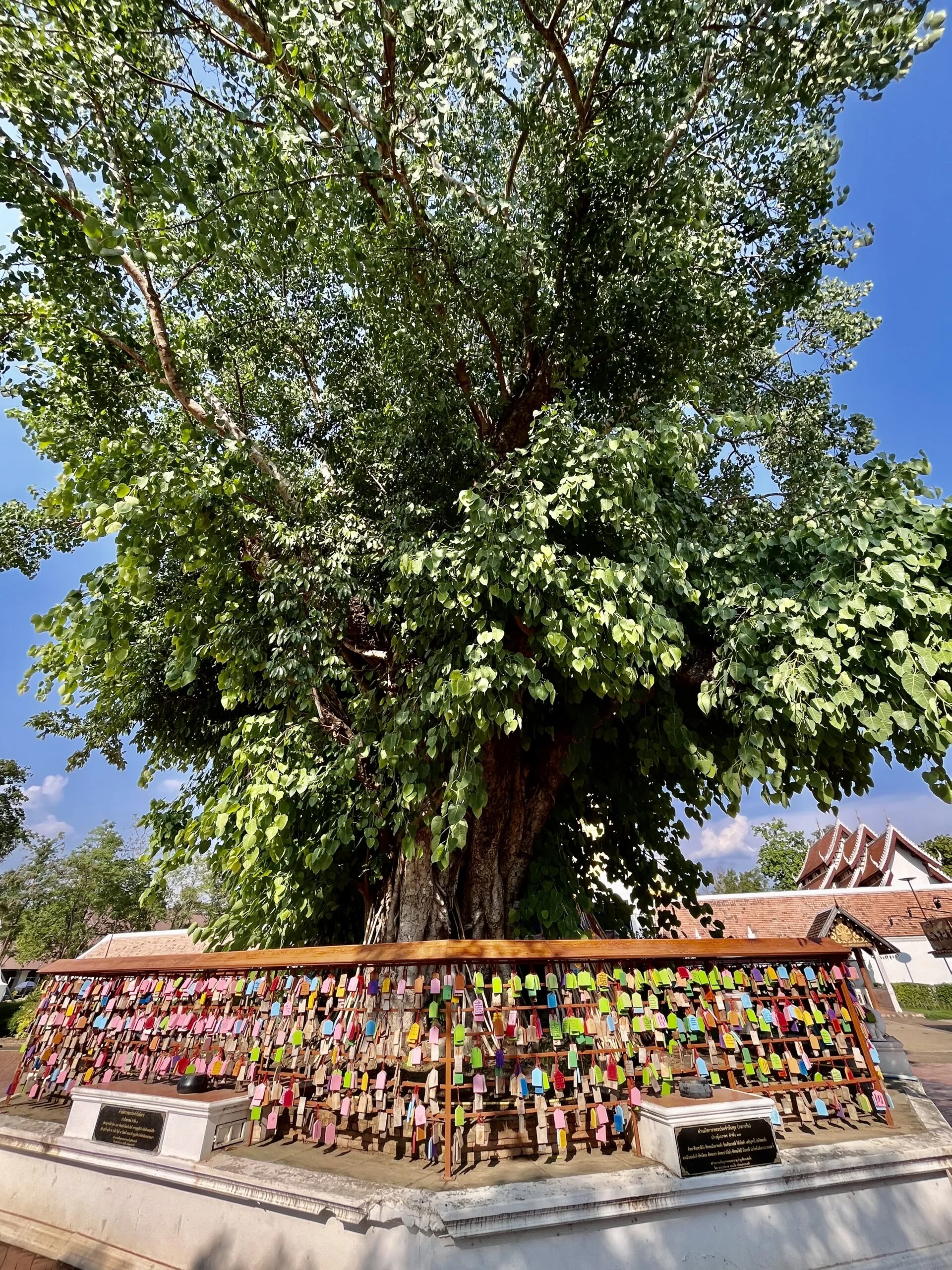
Large leafy green tree with a wooden fence surrounding it, with colourful tags tied to the fence.
Bodhi tree at Wat Phrathat Chae Haeng in Nan province, Thailand. According to the principles of 'khud', the Bodhi tree cannot be felled (photograph by Alisa Santikarn, April 2025)
The name you would like to be credited with for your contribution.
The word you wish to contribute
Your email for contact and updates regarding your submission.
The language you are contributing the word in
Maximum file size: 3 MB
Maximum file size: 5 MB
By proceeding, I acknowledge and agree to GloCo's Legal notice and Terms of use
and the Guidelines for Contributors *

Related Words

IMG_3464 2
ลงรักปิดทอง/Long Rak Pit Thong
Thai

ลงรักปิดทอง/Long Rak Pit Thong, or ‘lacquering and gilding’, is both a Thai conservation technique and an act of worship and a way of making merit wit...

960px-Ephemera_collection;_Paper_bag_advertising_Bile_Beans_Wellcome_L0030503
Aassammeln
Deutsch

Eine Erweiterung des Vergleichs von Sammeln mit Jagd (zb. bei Donna Haraway). Hier wird extern ein Rahmen vorgegeben und die zu sammelnden Bilder etc....

960px-_Der_Weltkrieg__(Zigarettenalbum)_-_Einzelseite
Zigarettensammelalbum
Deutsch

Bei Zigarettenschachteln wurden aus Werbe- und Propagandazwecken Bilder beigelegt. Besonders bekannt und eine der ersten waren Baseballcards in den US...

ម្ចាស់ទឹកម្ចាស់ដី / Mchas Teuk, Mchas Dei
Khmer
mcheasatukamcheasadei

គេ​តែងតែ​គោរព​ពពួក​អស់​នឹង ព្រោះ​ពពួក​អស់​នឹង​គេ​តាម​បីបាច់​ថែរក្សា​យើង ហើយ​ខ្លះ​ទៀត ពេល​ណា​ដែល​ម្ចាស់ផ្ទះ​មាន​គ្រោះ មាន​ភ័យ មាន​អន្តរាយ​អ្វីមួយ​កើត​ម...

Shrine PP
ព្រះភូម / Preah Phum
Khmer

អ​ញ្ចឹ​ង​ពពួក​ភូមិ​ទេវតា តាម​ការពារ និង​ថែរក្សា​ម្ចាស់ផ្ទះ​នឹង ទាល់តែ​ម្ចាស់ផ្ទះ​នឹង​ជា​អ្នកមាន​ទាន មាន​សីល មាន​សេចក្តី​ល្អ ប្រព្រឹត្ត​សេចក្តី​ល្អ​ដែរ...

Spirit House
ម្រេញគង្វាល / Mrenh Kongveal
Khmer
m'renh kung'viel

ម្រេញគង្វាល គឺជាភពអមនុស្ស ដែលជាកញ្ចក់ឆ្លុះបញ្ចាំងពីភពរបស់យើង ដែលភាគច្រើនយើងតែងតែហៅក្មេងឃ្វាលគោ ឃ្វាល ក្របី។ ដោយសាររឿងហ្នឹងវាទាក់ទងបាយសំណុំ ទឹកបំពង់ ដែ...

Shrine
រានទេវតា / Rean Devata
Khmer
rien tevada

ព្រះភូមទេវតា ឬរានទេវតានេះ គេដាក់នឹង គឺភាគច្រើនគេដាក់សម្រាប់ឱ្យពពួកភូមទេវតារស់នៅ មានដូចជាអរុក្ខទេវតា ភូមិទេវតាដែលយើងហៅថាម្រេញគង្វាល ។ ហើយការដាក់ទាំងអស់...

Cambodia_2014_-_panoramio_(12)
លោកតាស្នាប់ / Lok Ta Snap
Khmer

អ្នកដែលមិនជឿលើព្រះបិតា លោកតាស្នាប់ បានជួបប្រទះអភ័យហេតុផ្សេងៗគ្នា៖ ម៉ូតូរបស់ពួកគេខូចនៅពេលបើកចូលព្រៃ ខណៈដែលមនុស្សខ្លះវិលត្រឡប់មកវិញបានដួលចេញពីម៉ូតូ បាក់...

10602790_322080884634495_1776057173_n
Lilanje
Serbian

Lilanje je drevni narodni običaj, tipičan za stanovništvo istočne Bosne i zapadne Srbije, koji, prema starim vjerovanjima, datira iz perioda prije hri...

image
Sicanje/Bocanje
Serbo-Croatian

Postoji pretpostavka da ritual Sicanja/Bocanja, ili tradicionalni običaj tetoviranja među katolkinjama iz današnje Bosne i Hercegovine i nekih dijelov...

error: