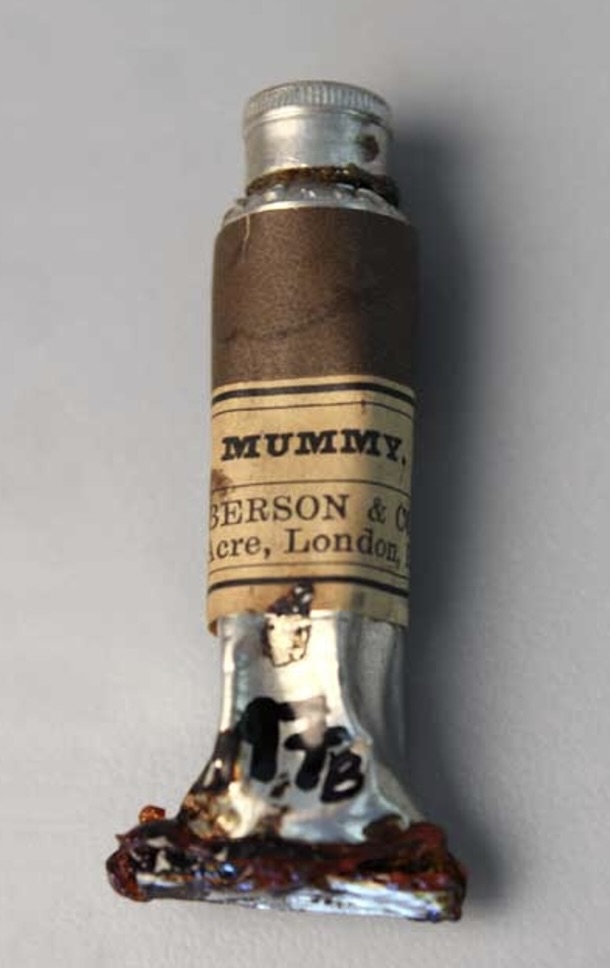
“Mummy brown” is one of the most enigmatic and ethically complex pigments in the history of Western art. Used primarily between the 17th and 19th centuries, it was a rich, transparent brown oil paint valued for its glazing properties. However, its allure is inextricably linked to its literal composition: the pulverized remains of ancient Egyptian humans and, occasionally, animals.
Origins and Materiality
The history of the pigment as pharmaceutical experimentalism. From the 12th century onward, “mumia” – bitumen and resinous materials found in or around mummies- was believed to have medicinal properties. Over time, the demand for this substance shifted from pharmacology to the arts.
Materially, “mummy brown” was a mixture of ground human flesh and bone, often combined with white pitch, myrrh, and various resins used in the mummification process. While it was sometimes confused with asphalt or bitumen, modern technical analysis has confirmed the presence of organic proteins and lipids, identifying the material as once-living tissue of a human being.
Artistic Appeal and Technical Decay
Artists were drawn to “mummy brown” for its unique aesthetic qualities. It offered a deep, warm transparency that was ideal for shadows, skin tones, and the “Old Master” look popularized during the 18th and 19th centuries. Notable users included the Pre-Raphaelites, such as Edward Burne-Jones, as well as European painters like Hans Makart, Angelika Kaufmann, Arnold Böcklin and Mihály Munkácsy.
However, the pigment proved to be a nightmare in terms of the longevity of the carrying artwork. Because of its organic and bituminous composition, it was notoriously unstable. It never fully dried, leading to a phenomenon known as “sinking,” where the paint darkened into a dull, muddy mass. It also caused severe “alligatoring” or deep cracking (cracklés anglais), which has permanently compromised the structural integrity of many 19th-century masterpieces.
Colonial Exploitation and Egyptomania
The production of “mummy brown” was a direct byproduct of European colonialism and “Egyptomania.” During the 19th century, Egyptian tombs were treated as industrial mines rather than sacred sites. Human remains were exported by the ton to fuel European markets, facilitated by diplomatic networks and trade routes that commodified colonized ancestors.
This trade transformed human bodies into “anthropological spoils” and decorative curiosities. The pigment industry served as a colonial economy where the physical history of Egypt was literally ground up to decorate the canvases of European elites.
Ethical Legacy and Modern Museums
The concept of “mummy brown” poses a significant challenge for modern museum ethics. Because the pigment was used so widely, hundreds of paintings in major galleries contain human remains, often without the public’s knowledge. This creates a “hidden” presence of the deceased within the museum space.
In the contemporary era, the pigment has become a symbol of the “darkness” within art history—not just in its visual hue, but in the moral implications of its production. Today, museums face the task of “material transparency,” deciding how to acknowledge the colonial violence and human cost embedded within the very layers of the paint. While the pigment officially went out of production in the mid-20th century (reputedly because the manufacturers “ran out of mummies”), its legacy remains as a permanent, physical record of the intersection between art, death, and imperial power.