Butterzopf

Language: Swiss German, German, French, Italian, Romansh
Contributors: Cedric Huss
Also known as: Ankezüpfe, Tresse, Treccia, Tarschola

Description

Butterzopf (Standard German) is a braided loaf of bread typically made from flour, milk, butter, yeast, and salt and brushed with egg before baking, although vegan versions have also become common. Though “Butterzopf” is often used as the Standard German term, many Swiss dialects have their own names for it. In Bern, for instance, where Butterzopf is thought to have originated in the late Middle Ages, it is widely known as Ankezüpfe. In Switzerland’s other linguistic regions, it is known as Tresse (French), Treccia (Italian), or Tarschola (Romansh), though many other regional names exist.

Traditionally, people prepare Butterzopf on Saturdays and eat it for breakfast on Sunday. Some people say that the dough must be banged on the table a hundred times to make a good Butterzopf. It is then divided into two pieces, which are shaped into long strands and braided by repeatedly crossing them over each other at right angles. Some people use electric kitchen machines to prepare the dough, while others simply buy their Butterzopf from a bakery or supermarket. Since Butterzopf is not very sweet, you can eat it either sweet, for example with jam or honey, or savory, for example with cheese.

Read more

Swiss German (bernese dialect)
„Butterzopf“ (Hochdütsch) isch äs gflochtnigs Brot, wo mä normalerwis us Mäu, Miuch, Ankä, Hefi und Sauz macht und vor em Bache mit Ei bstricht, aber mittlerwile gits o vegani Rezäpt. Obwou „Butterzopf“ hüfig dr hochdütsch Namä isch, hei viu schwizär Dialäkt eigäti Variationä. Z Bärn, zum Bispiel, wo dr Butterzopf schyns im Mittuauter isch erfungä wordä, sägä di meischtä Ankezüpfe. I angärnä Sprachregionä vor Schwiz seit mä Tresse (Französisch), Treccia (Italiänisch) oder Tarschola (Rätoromanisch), aber äs git no ä Hufä angeri Nämä.

Traditionell macht mä ä Züpfä am Samschdi und isst sä am Suntig zum Zmorgä. Äs git Lüt wo sägä, mä müäss dr Teig hundert Mau ufä Tisch houä, dass äs ä guäti Züpfä git. Denn macht mä drus zwöi Bitzä, wo mä zu Sträng formät und denn übers Chrüz flächtät. Deu Lüt bruchä zum Teig machä elektrischi Chuchimaschinä und anderi choufä dr Zopf bim Beck oder im Ladä. Wöu ä Züpfä nid so süäss isch, cha mä sä süäss ässä, zum Bispiel mit Gonfi oder Honig, oder sauzig, zum Bispiel mit Chäs.

French
La tresse est un pain tressé que l’on prépare généralement avec de la farine, du lait, du beurre, de la levure et du sel, puis que l’on badigeonne d’œuf avant la cuisson. Depuis quelques années, il existe aussi des recettes véganes. Bien que « Butterzopf » soit souvent utilisé comme terme en allemand standard, de nombreux dialectes suisses allemands en ont leurs propres variantes. À Berne, par exemple, où la tresse aurait été inventée au Moyen Âge, la plupart des gens disent Ankezüpfe. Dans les autres régions linguistiques de Suisse, on dit Treccia (italien) ou Tarschola (romanche), mais il existe encore de nombreuses autres appellations.

Traditionnellement, on prépare une tresse le samedi et on la mange au petit-déjeuner le dimanche. Certaines personnes disent qu’il faut frapper la pâte contre la table cent fois pour obtenir une bonne tresse. Ensuite, on divise la pâte en deux morceaux que l’on façonne en longs brins avant de les tresser en les croisant successivement. Il y a des gens qui préfèrent utiliser des appareils de cuisine électriques pour préparer la pâte, tandis que d’autres achètent simplement leur tresse à la boulangerie ou au supermarché. Comme la tresse n’est pas très sucrée, on peut la manger aussi bien avec des accompagnements sucrés, par exemple de la confiture ou du miel, qu’avec des accompagnements salés, par exemple du fromage.

If anyone wants to add Italian and Romansh, please feel free.

Date of entry: September 3, 2026
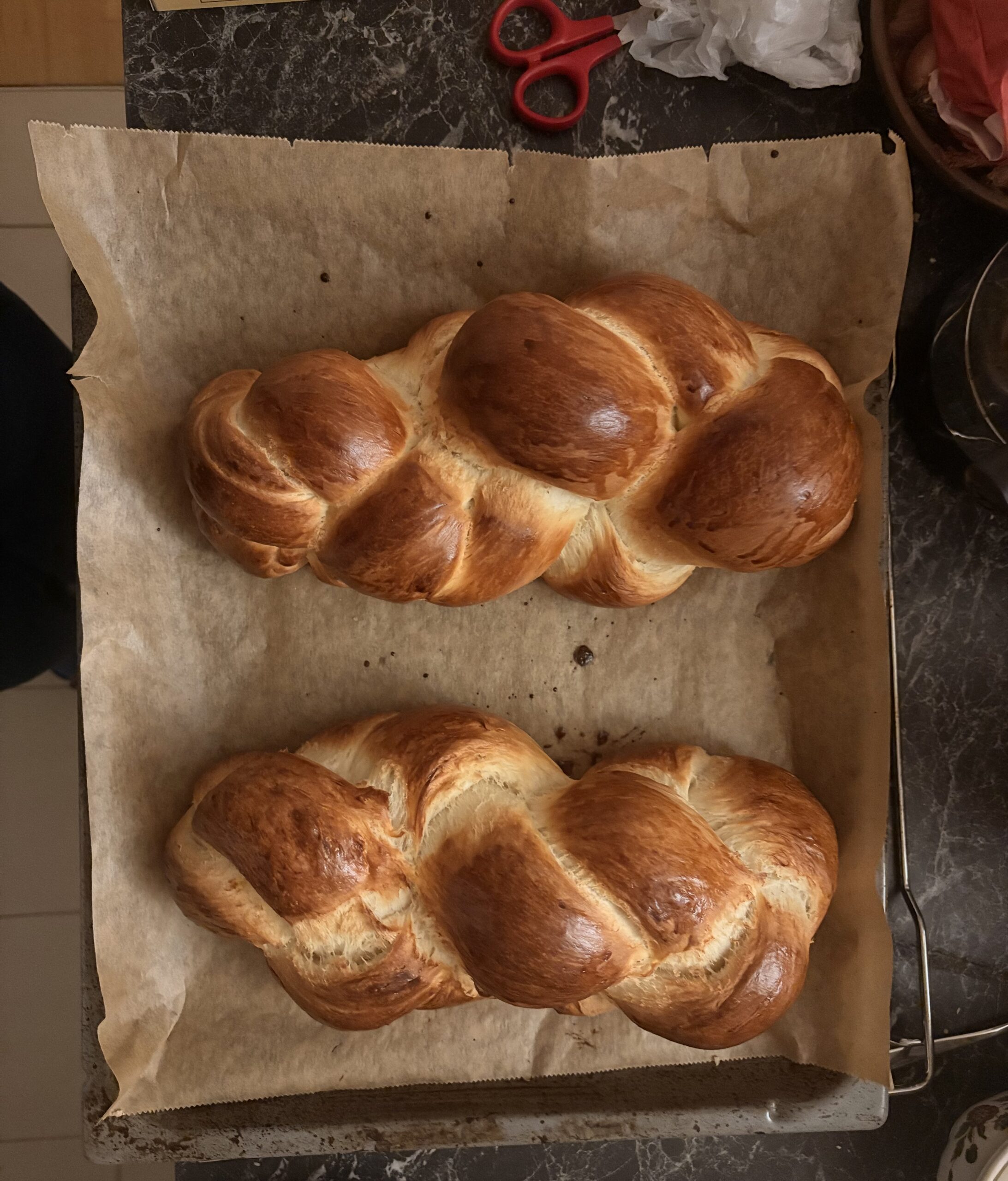
Ankäzüpfä/Tresse/Treccia/Tarschola after baking.
The name you would like to be credited with for your contribution.
The word you wish to contribute
Your email for contact and updates regarding your submission.
The language you are contributing the word in
Maximum file size: 3 MB
Maximum file size: 5 MB
By proceeding, I acknowledge and agree to GloCo's Legal notice and Terms of use
and the Guidelines for Contributors *

Related Words

masticated-work
Masticated Work (Hairwork)
English

Masticated work, sometimes called cut work or sepia work, is a hairwork technique in which hair is finely chopped or ground into a powder, mixed with ...

table-work
Table Work (Hairwork)
English

Table work refers to a wide range of hairwork techniques that involve braiding and weaving hair into a jewelry. The name comes from the apparatus at t...

palette-work
Palette Work (Hairwork)
English

Palette work is a hairwork technique that involves flattening a lock of hair onto a piece of glass, covering it with gum tragacanth (sometimes referre...

gimp-work
Gimp Work (Hairwork)
English

Gimp work (sometimes called wire work) refers to an extremely intricate form of hairwork that involves looping strands of hair around a pin or wire to...

Picture1
Hairwork
English

Hairwork refers to the long and varied tradition of crafting objects, images, and keepsakes from the hair of loved ones. While the practice is now mos...

960px-Ephemera_collection;_Paper_bag_advertising_Bile_Beans_Wellcome_L0030503
Aassammeln
Deutsch

Eine Erweiterung des Vergleichs von Sammeln mit Jagd (zb. bei Donna Haraway). Hier wird extern ein Rahmen vorgegeben und die zu sammelnden Bilder etc....

960px-_Der_Weltkrieg__(Zigarettenalbum)_-_Einzelseite
Zigarettensammelalbum
Deutsch

Bei Zigarettenschachteln wurden aus Werbe- und Propagandazwecken Bilder beigelegt. Besonders bekannt und eine der ersten waren Baseballcards in den US...

9-Tempel
Oriental Museum (Vienna)
English

The Oriental Museum in Vienna was a museum dedicated to promoting trade relations between the Austro-Hungarian Empire and the countries of the so-call...

Screenshot-2026-01-17-at-16.32.12-1
Mummy brown
English

“Mummy brown” is one of the most enigmatic and ethically complex pigments in the history of Western art. Used primarily between the 17th and 19th cent...

Emailleschildmalen_Zita-Breu
Emailschilder Beschriftung
Deutsch (Österreich)
[ˈeːmaɪ̯ʃɪldɐ bəˈʃʁɪftʊŋ]

Die Bemalung der Emailschilder wird auf beidseitig mehrschichtig weiß emailliertes, leicht gewölbtes Kupferblech aufgebracht. Die Schriftenmalerei wir...

error: