Wolpertinger

Pronunciation: Wol-per-dinga
Language: Bavarian
Also known as: Bavarian mythical creature

Description

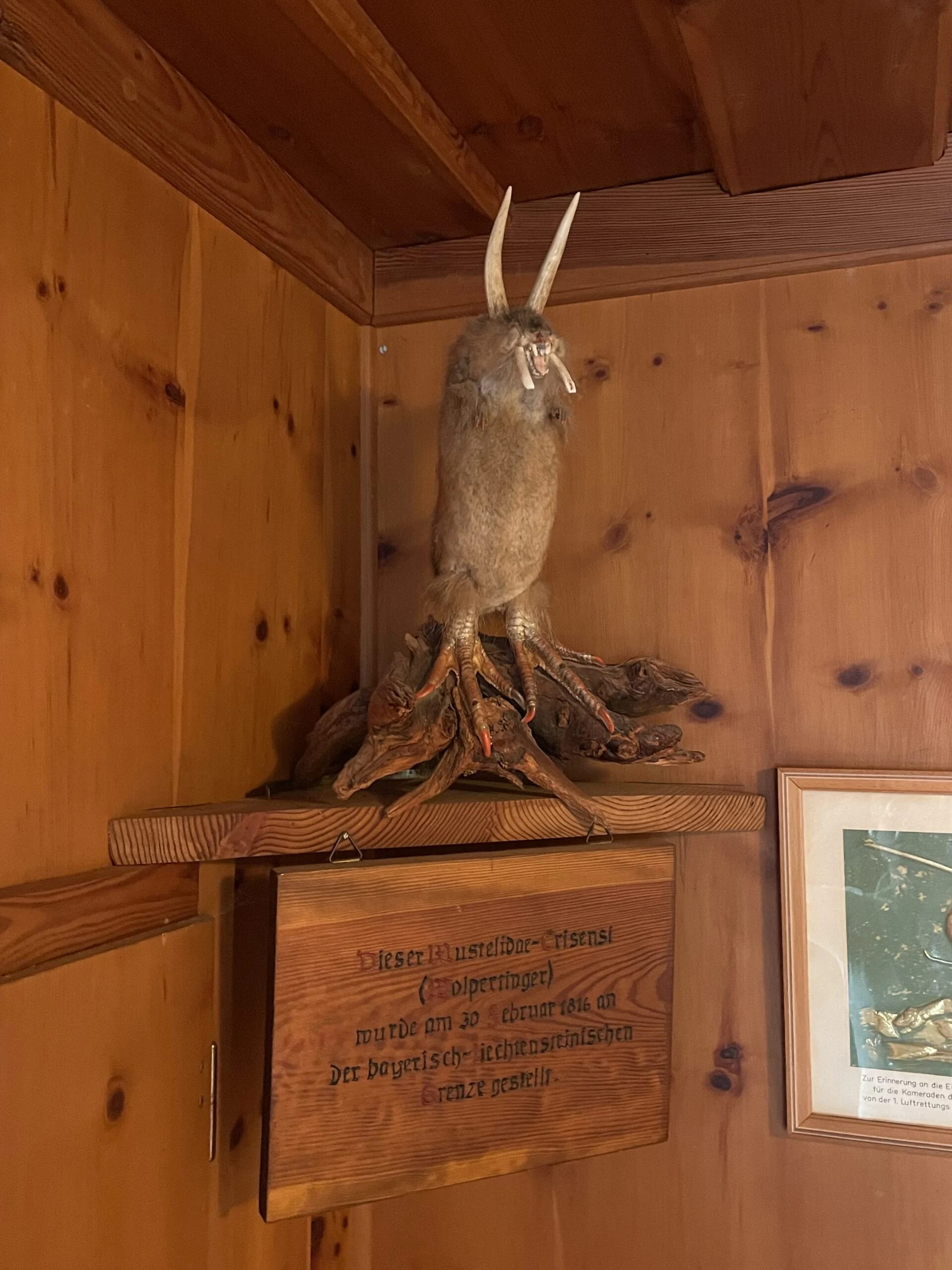
Der Wolpertinger ist ein bayerisches Fabelwesen. Er ist ein Mischwesen, das oft aus dem Körper eines Kaninchens, dem Geweih eines Rehbocks und den Flügeln einer Eule besteht. Niemand hat es je gesehen, aber es hängt oft ausgestopft an den Wänden von Jägern zwischen Geweihen anderer Jagdtrophäen. Aus welchen Tieren ihre Körper zusammengesetzt sind kann jedoch variieren, da sie entstehen, wenn sich die Wildtiere des Waldes miteinander paaren. Die Geschichten über den Wolpertinger werden den meisten bereits als Kind erzählt und handeln von einem Tier, dessen Speichel überall dort Haare wachsen lässt, wo er die menschliche Haut berührt. Es ernährt sich gerne von Schädeln von Preußen, seine Größe und sein Gewicht sind unbekannt, aber die Tiere sind nie zu groß, um sie hochzuheben. Man sagt, dass sie nur fünfzehn Tage vor einem Gewitter jagen. Eine Legende erzählt auch, wie man dieses Fabelwesen fangen kann. In der Regel können nur junge, hübsche Frauen in Begleitung eines fähigen Mannes, der ihre Höhlen kennt, das Tier finden und fangen. Sie müssen sich dann mit einem Sack, einem Spaten und einer Kerze bei Vollmond auf den Weg machen. Sie muss den Beutel dann mit dem Stock offenhalten und eine Kerze vor die Höhle des Wolpertingers stellen. Durch das Licht angelockt, hüpft das Wesen einfach in den Sack. Diese Geschichten erfreuen noch heute viele Kinder und werden nicht nur in vielen bayerischen Familien lebendig gehalten. Das Fabelwesen ist sogar im Deutschen Jagd- und Fischereimuseum in München ausgestellt.

Read more

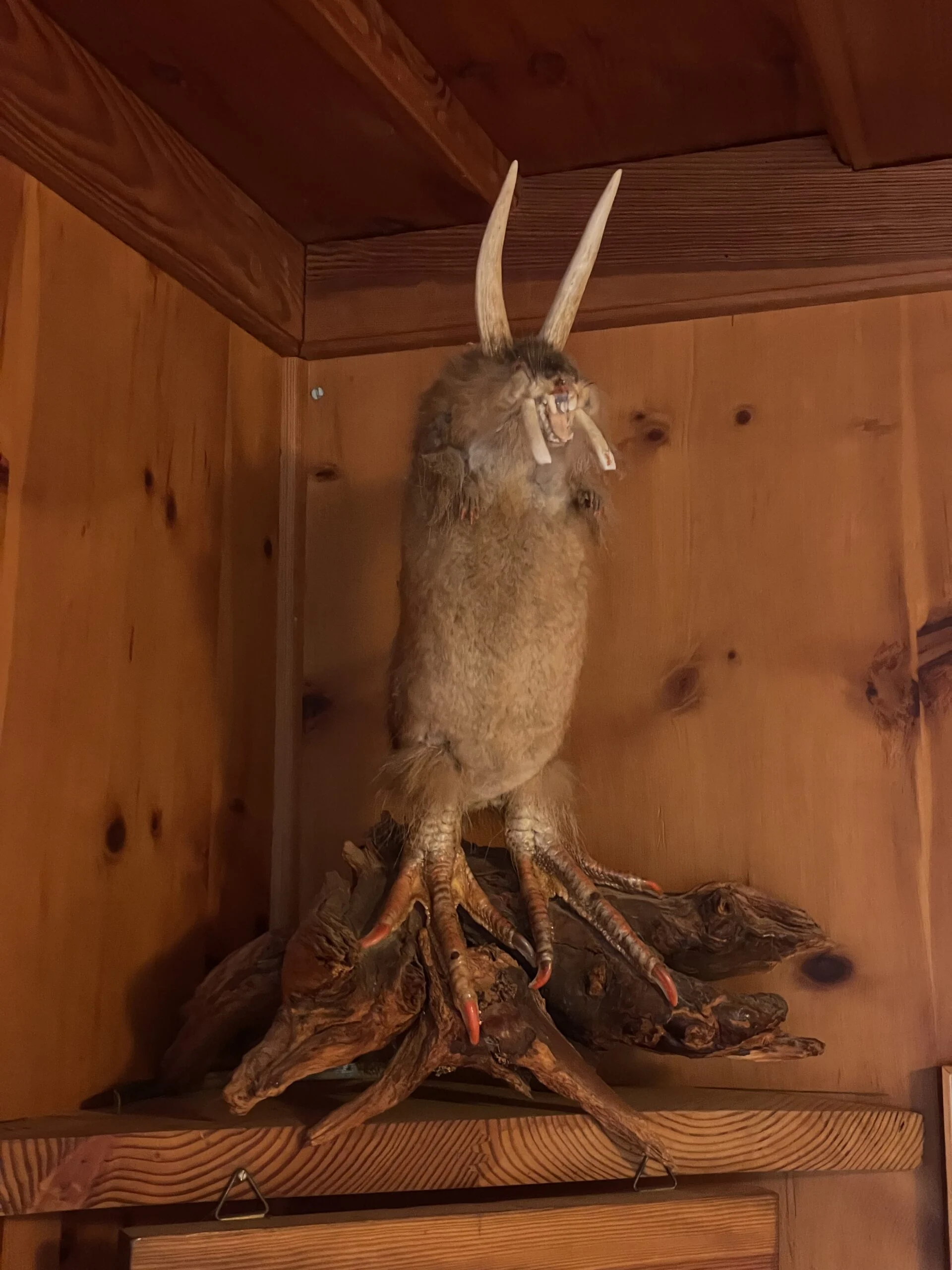
Hybrid mythical creature in Bavarian folklore, generally consisting of the body of a rabbit, the antlers of a roebuck, and the wings of an owl. Stuffed models can often be found hanging on hunters’ walls, among the antlers of other hunting trophies. It is said to be the offspring of wild animals, and as such, the specific composition of the Wolpertinger may vary. Stories of the Wolpertinger are mostly told to children, and describe an animal whose saliva causes hair to grow wherever it touches human skin. In these stories, the Wolpertinger feeds on the skulls of Prussians, and though its size and weight are unknown, it is never too big to lift. It is said to hunt only fifteen days before a thunderstorm, and in order to catch one, certain rules have to be met: a young, pretty woman accompanied by a capable man with knowledge of the Wolpertinger’s caves must set out with a bag, spade, and candle under a full moon. The woman holds the bag open with the stick and places a candle in front of the Wolpertinger’s den. Lured by the light, the creature simply hops into the bag. These stories still amuse children today and are kept alive by many Bavarian families, as well as others. A mock-up of the mythical creature is even on display in the Deutsche Jagd- und Fischereimuseum (German Hunting and Fishing Museum) in Munich.

Date of entry: June 18, 2025
Wolpertinger figure in „Blaueishütte“ in the Bavarian Alps by Franziska Wasserberg
The name you would like to be credited with for your contribution.
The word you wish to contribute
Your email for contact and updates regarding your submission.
The language you are contributing the word in
Maximum file size: 3 MB
Maximum file size: 5 MB
By proceeding, I acknowledge and agree to GloCo's Legal notice and Terms of use
and the Guidelines for Contributors *

Related Words

P1080718_Louvre_salle_711_rwk
Conservation Washing
English

Since 2023, I have developed the concept of "conservation washing", which exploits the vulnerability of heritage and art to argue against the relocati...

MAK_t-6907_lotto-teppich_1-1
Lotto-Teppich
Deutsch

Als Lotto-Teppiche werden geknüpfte Wollteppiche bezeichnet, deren typisches Muster aus gelben, geometrisierten Ranken auf rotem Grund besteht. Sie wu...

Wien-Museum-Online-Sammlung-M-10120
Reformkleid/Künstlerkleid
Deutsch

Als Reformkleid wird ein Kleid bezeichnet, das lose von den Schultern herabhängt, bequem weite Ärmel hat und ohne Korsett getragen werden sollte. Vora...

IMG_3281
Restorative Justice
English

In the heritage sector, Restorative Justice encompasses improving conservation conditions while collections are held in Western institutions and conne...

masticated-work
Masticated Work (Hairwork)
English

Masticated work, sometimes called cut work or sepia work, is a hairwork technique in which hair is finely chopped or ground into a powder, mixed with ...

table-work
Table Work (Hairwork)
English

Table work refers to a wide range of hairwork techniques that involve braiding and weaving hair into a jewelry. The name comes from the apparatus at t...

palette-work
Palette Work (Hairwork)
English

Palette work is a hairwork technique that involves flattening a lock of hair onto a piece of glass, covering it with gum tragacanth (sometimes referre...

gimp-work
Gimp Work (Hairwork)
English

Gimp work (sometimes called wire work) refers to an extremely intricate form of hairwork that involves looping strands of hair around a pin or wire to...

Picture1
Hairwork
English

Hairwork refers to the long and varied tradition of crafting objects, images, and keepsakes from the hair of loved ones. While the practice is now mos...

IMG_4762
Luminarias
English, Spanish

Luminarias are a type of paper lantern used to decorate backyards, walkways, and roofs (particularly on flat, adobe-style buildings) in New Mexico and...

error: