Conservation Transparency

Language: English
Contributors: Kshetrimayum Kamaljit Singh

Description

Conservation transparency refers to the principle and practice of making conservation processes, decisions, and documentation visible, accessible, and accountable to a wider range of stakeholders — including researchers, institutions, source communities, and the public.

Traditionally, conservation has been positioned as a highly specialized professional domain, where technical knowledge, treatment decisions, and scientific data remain largely internal to institutions or expert circles. Documentation often exists, but access to it is uneven, restricted, or mediated through institutional authority. Conservation transparency challenges this model by asking not only what is done to cultural objects, but also who gets to know about it, how that knowledge circulates, and for whose benefit.

In practical terms, conservation transparency may involve:
open access to treatment reports and technical documentation, clear communication of conservation decisions and uncertainties, disclosure of materials, methods, and ethical reasoning, sharing conservation data with source communities, acknowledging limitations, risks, and failures in practice.

Transparency reframes conservation as a dialogic process rather than a closed technical operation. It recognizes that conservation actions actively shape the future meaning, materiality, and interpretation of heritage, and therefore carry ethical and cultural implications beyond the laboratory or museum store.

From an ethical perspective, conservation transparency is closely linked to questions of authority and trust. When documentation is partial, inaccessible, or selectively curated, conservation knowledge becomes a form of institutional power. Transparency, in contrast, redistributes that power by allowing others to scrutinize, question, reinterpret, and participate in conservation narratives.

However, conservation transparency is not simply about publishing more data. It raises complex tensions around intellectual property, professional liability, cultural sensitivity, and the potential misuse of technical information. What should be made visible, to whom, and under what conditions remains an ongoing negotiation rather than a fixed standard.

Seen in this way, conservation transparency is less a technical policy and more a critical stance: it invites conservators and institutions to reflect on their role as knowledge producers, cultural mediators, and ethical agents within broader social and political frameworks.

Read more

Conservation transparency refers to the degree to which conservation processes, decisions, and documentation are openly accessible, understandable, and accountable to stakeholders beyond institutional experts.

Date of entry: February 23, 2026
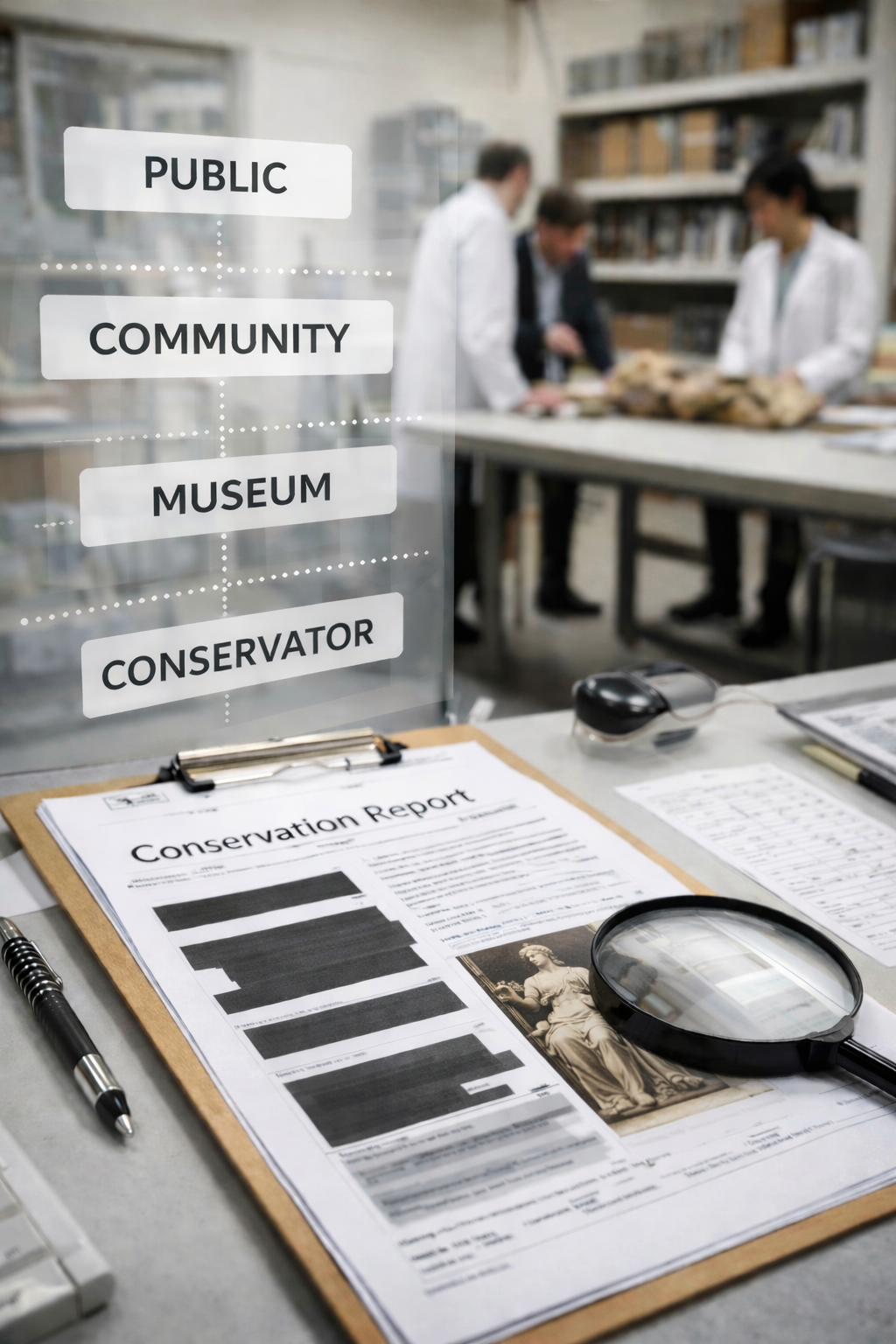
Image: Conceptual illustration generated using AI by the author to visualise the idea of conservation transparency. This image is not a documentary representation of an actual institution or object.
The name you would like to be credited with for your contribution.
The word you wish to contribute
Your email for contact and updates regarding your submission.
The language you are contributing the word in
Maximum file size: 3 MB
Maximum file size: 5 MB
By proceeding, I acknowledge and agree to GloCo's Legal notice and Terms of use
and the Guidelines for Contributors *

Related Words

P1080718_Louvre_salle_711_rwk
Conservation Washing
English

Since 2023, I have developed the concept of "conservation washing", which exploits the vulnerability of heritage and art to argue against the relocati...

MAK_t-6907_lotto-teppich_1-1
Lotto-Teppich
Deutsch

Als Lotto-Teppiche werden geknüpfte Wollteppiche bezeichnet, deren typisches Muster aus gelben, geometrisierten Ranken auf rotem Grund besteht. Sie wu...

Wien-Museum-Online-Sammlung-M-10120
Reformkleid/Künstlerkleid
Deutsch

Als Reformkleid wird ein Kleid bezeichnet, das lose von den Schultern herabhängt, bequem weite Ärmel hat und ohne Korsett getragen werden sollte. Vora...

IMG_3281
Restorative Justice
English

In the heritage sector, Restorative Justice encompasses improving conservation conditions while collections are held in Western institutions and conne...

masticated-work
Masticated Work (Hairwork)
English

Masticated work, sometimes called cut work or sepia work, is a hairwork technique in which hair is finely chopped or ground into a powder, mixed with ...

table-work
Table Work (Hairwork)
English

Table work refers to a wide range of hairwork techniques that involve braiding and weaving hair into a jewelry. The name comes from the apparatus at t...

palette-work
Palette Work (Hairwork)
English

Palette work is a hairwork technique that involves flattening a lock of hair onto a piece of glass, covering it with gum tragacanth (sometimes referre...

gimp-work
Gimp Work (Hairwork)
English

Gimp work (sometimes called wire work) refers to an extremely intricate form of hairwork that involves looping strands of hair around a pin or wire to...

Picture1
Hairwork
English

Hairwork refers to the long and varied tradition of crafting objects, images, and keepsakes from the hair of loved ones. While the practice is now mos...

IMG_4762
Luminarias
English, Spanish

Luminarias are a type of paper lantern used to decorate backyards, walkways, and roofs (particularly on flat, adobe-style buildings) in New Mexico and...

error: