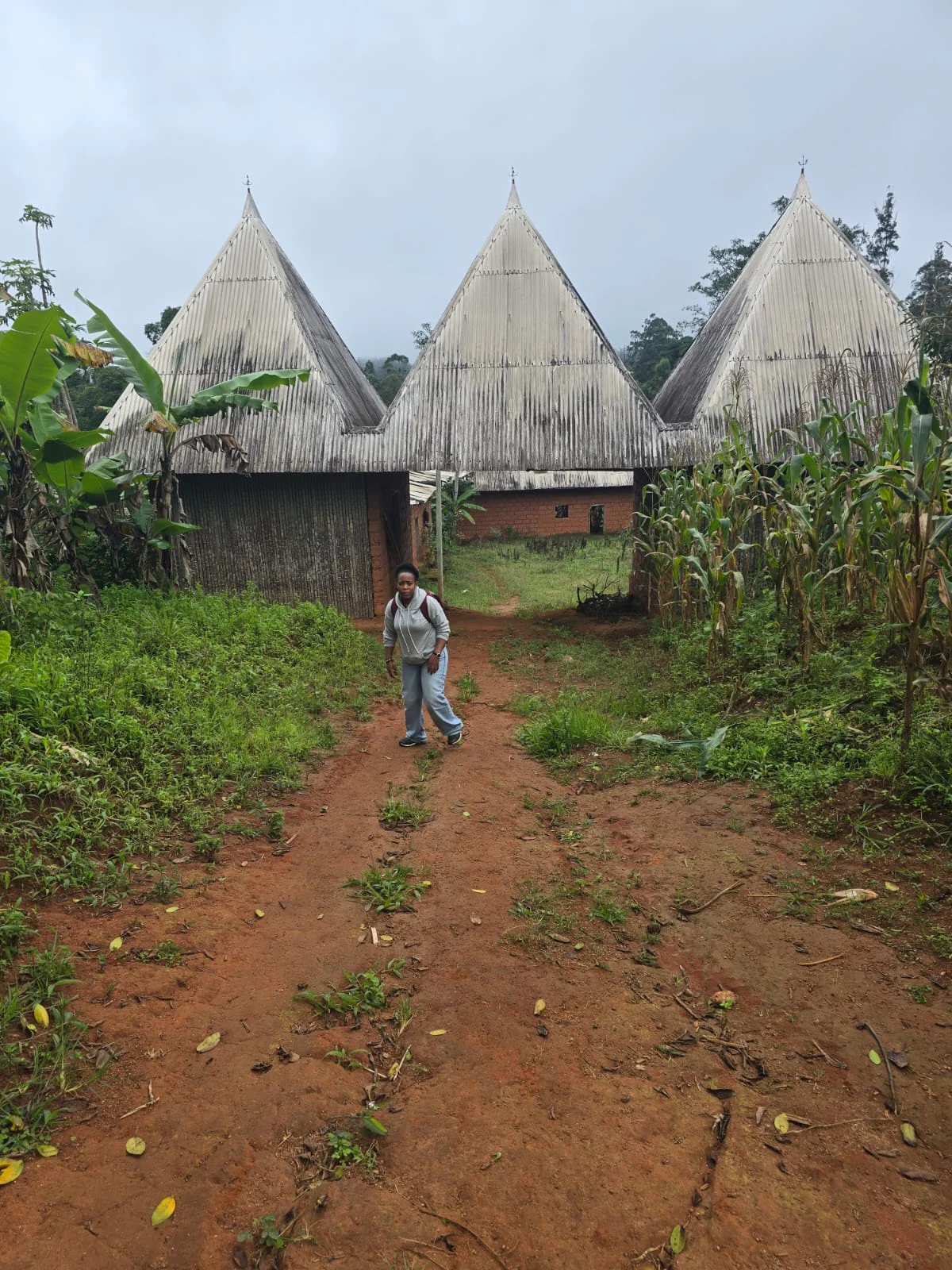
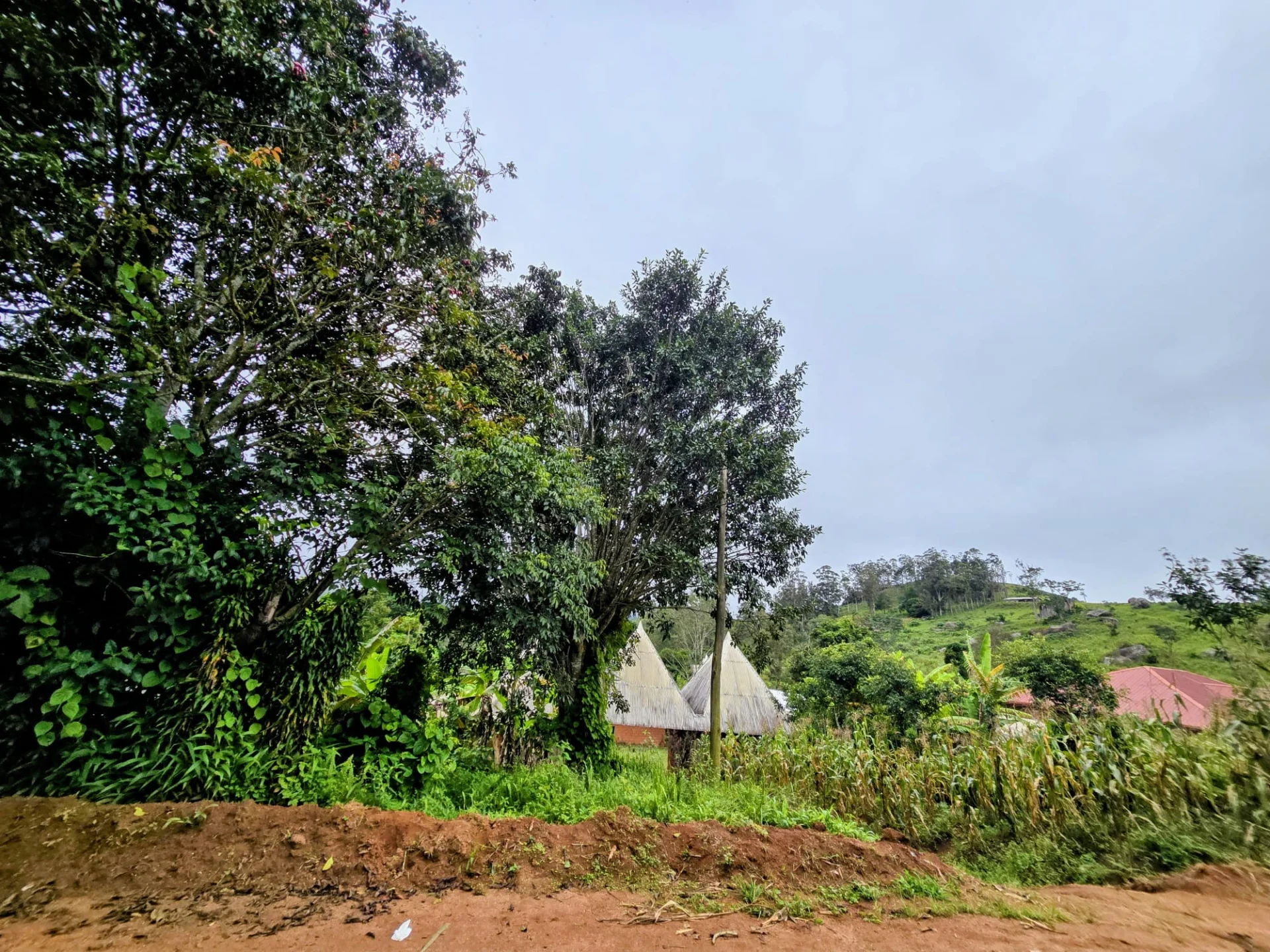
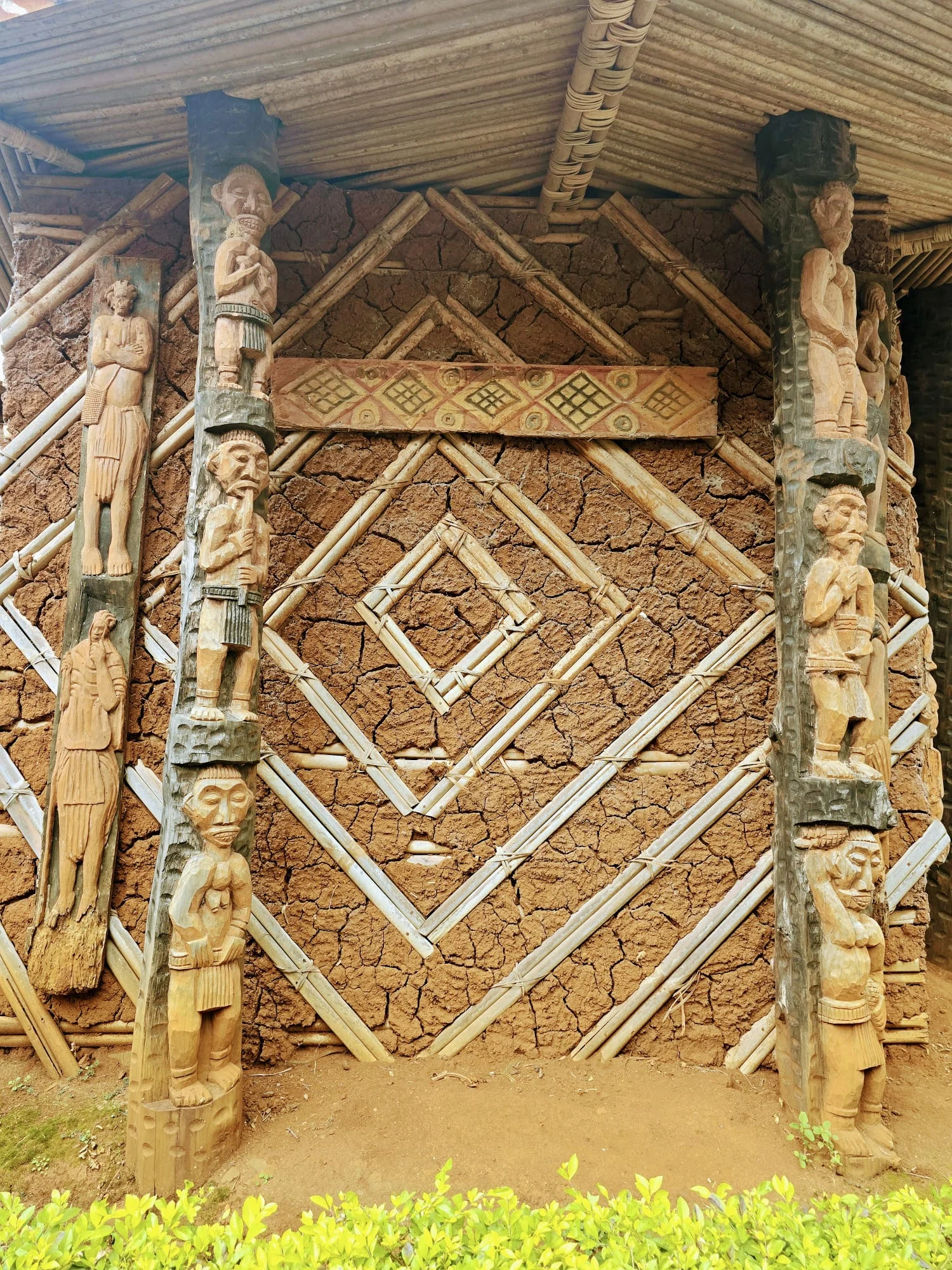
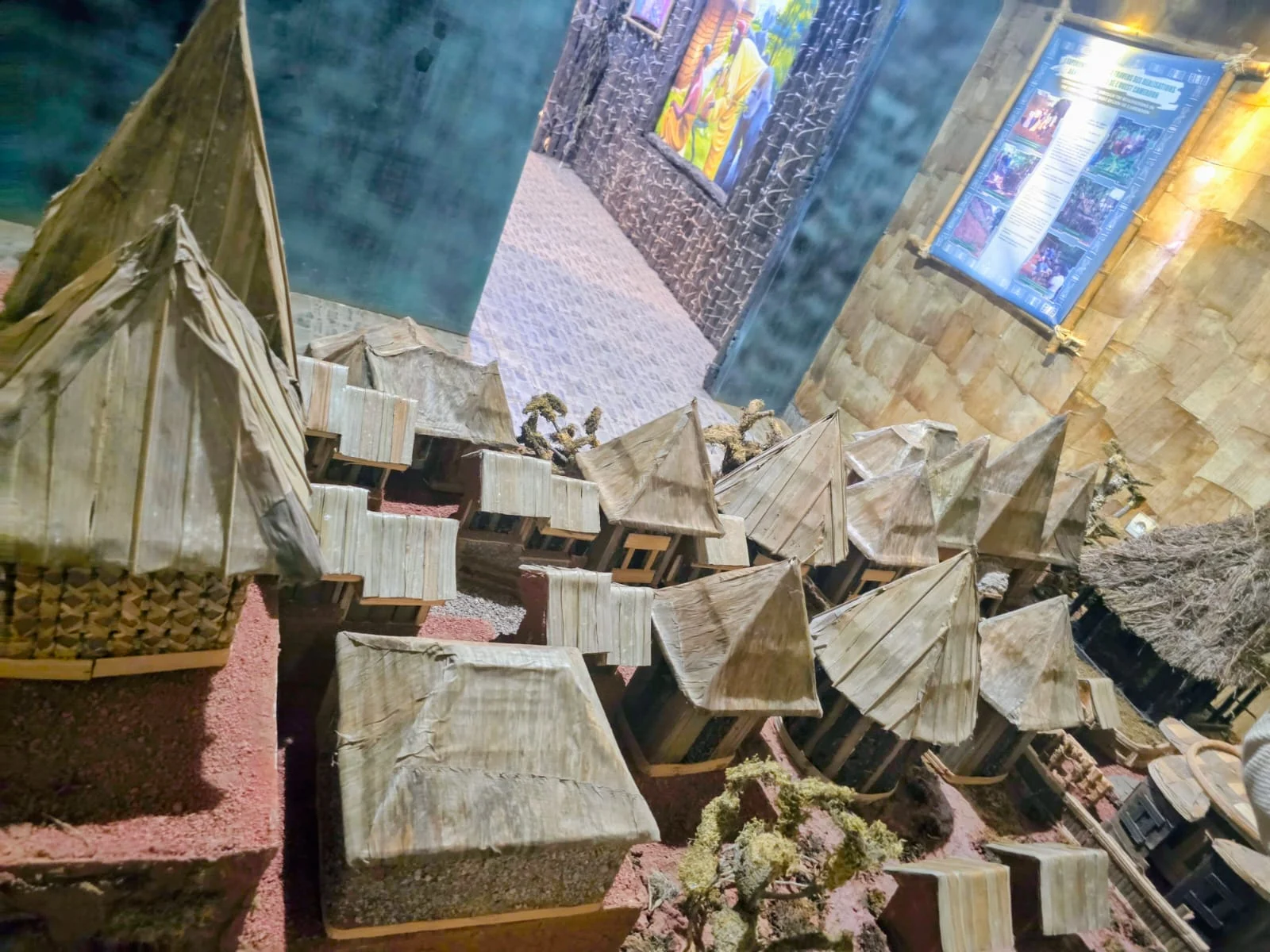
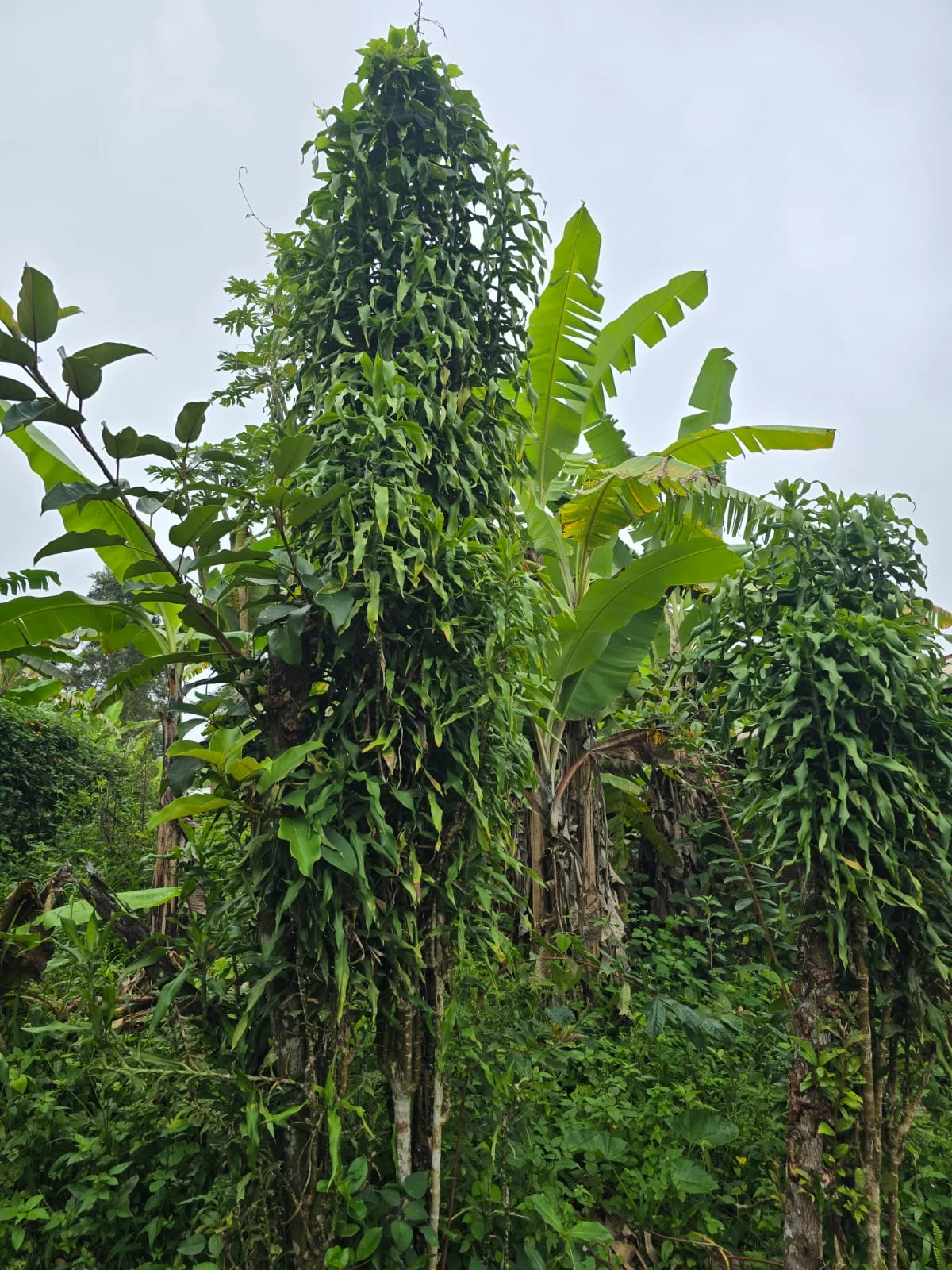
A family estate comprising a meeting place, a paternal house and the women’s houses. The compound is the basis of Bamiléké socio-political organization. It is with in this living space that family life is organized. Its importance depends on the social status of the head of the family. The compound is very often located on a hillside, and generally surrounded by a Bocage (haie vive). In case of a polygamist husband the main driveway (Ntↄ) is flanked on both sides by the women’s houses. It leads to a large ceremonial courtyard (tǝtↄ or Tǝtà), in front of which is the reception vestibule (Kↄ’ↄ). Behind this vestibule are several other buildings, each with a specific function and whose existence marks the social status of the head of the family. These include: the house of the head of the family, the meeting or ceremonial house (if the head of the family is a Nkam (ŋkǎm)), the company house, the granary (see Ŋkiŋ/chýɛ̀ ndǝ́ also called Ntɛ or Ntaŋ, ) or the cattle yard (Hurault 1962, 9-10). Behind this building, a sacred place dedicated to the family’s deities is housed and protected. Down below, a swamp colonized by raffias. This group of dwellings is surrounded by fields, separated from one another by hedgerows through which the cattle move. It should be noted that this Mba/Mbè (mbɛ̀) structure was gradually abandoned with colonial influence and demographic growth. Nevertheless, it has been preserved in the homes of certain notables.
Domaine familial comportant un espace de réunion, une maison paternelle et des maisons de femmes. La concession est la base de l’organisation sociopolitique bamiléké. C’est au sein de cet espace d’habitation que s’organise la vie familiale. Son importance dépend du statut social du chef de famille. La concession est très souvent située sur un versant, en contre-bas d’une colline, et elle est généralement entourée par une Bocage (haie vive). L’allée principale (Ntↄ) qui y accède est longée de part et d’autre par les maisons des femmes, lorsqu’il s’agit du Mba/Mbè (mbɛ̀) d’un mari polygame. Elle donne à une grande cour de cérémonie (tǝtↄ ou Tǝtà) devant laquelle se trouve le vestibule d’accueil (Kↄ’ↄ). Derrière ce vestibule se trouvent plusieurs autres bâtisses qui, chacune, possède une fonction précise et dont l’existence marque le statut social du chef de famille. Ce sont par exemple : la maison du chef de famille, la maison de réunion ou de cérémonie (si le chef de famille est un Nkam (ŋkǎm)), la maison des sociétés, le grenier ( voir Ŋkiŋ/chýɛ̀ ndǝ́ Ntɛ ou Ntaŋ) ou encore le parc à bétail (Hurault 1962, 9-10). Derrière cette bâtisse se trouve, emménagé et protégé, un lieu sacré dédié aux divinités de la famille. Puis, en contre-bas, un marécage colonisé par les raphias. Cet ensemble d’habitation est entouré de champ, séparés les uns des autres par des allées de haies à travers lesquelles circule le bétail. Il faut noter que cette structure du Mba a peu à peu été abandonnée avec l’influence coloniale et la montée démographique. Néanmoins elle a été préservée dans les habitations de certains notables.

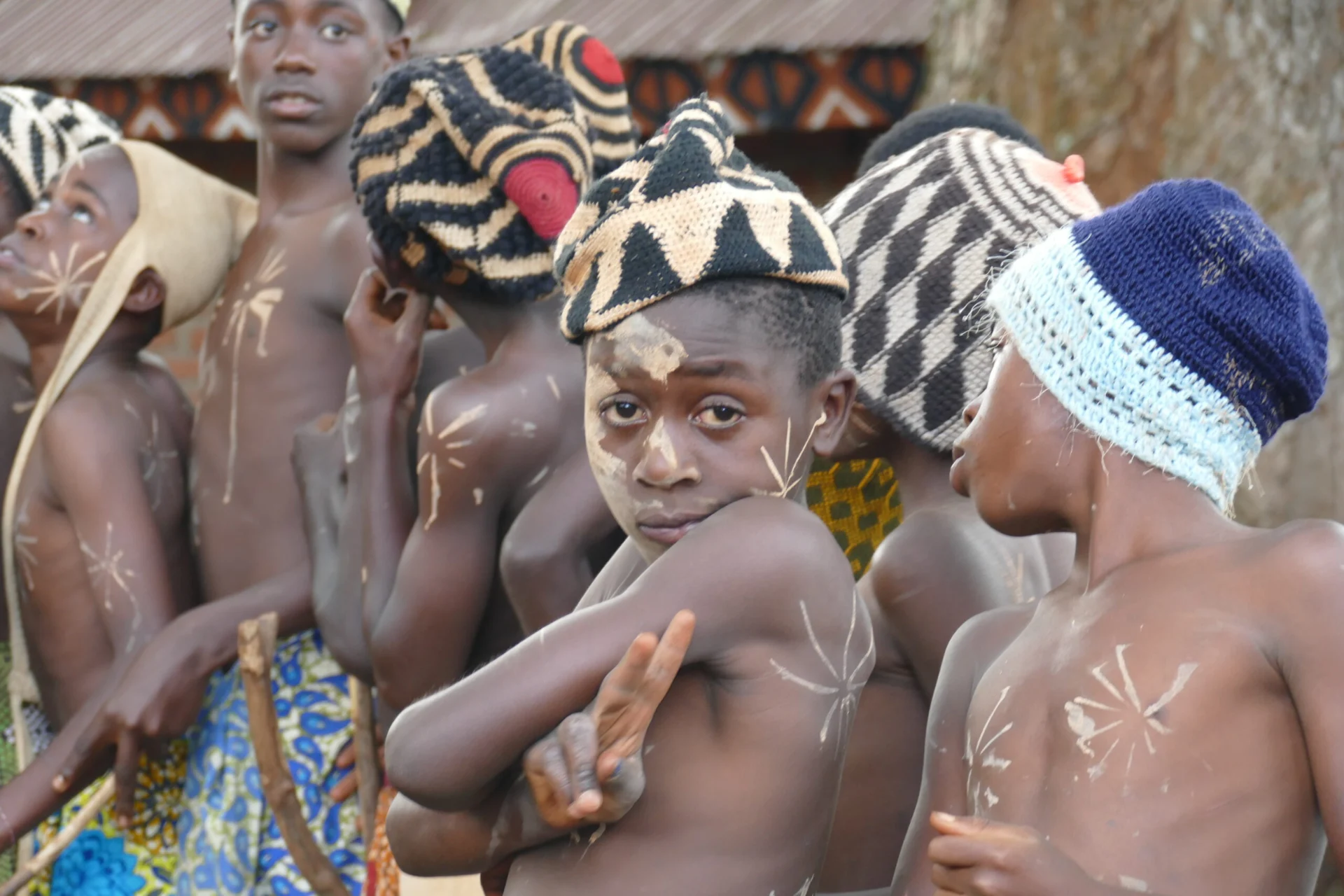
The word means hat. There are many different types, from royal headdresses to simple hats, Nkam (ŋkǎm)' hats and headdresses worn by the members of t...
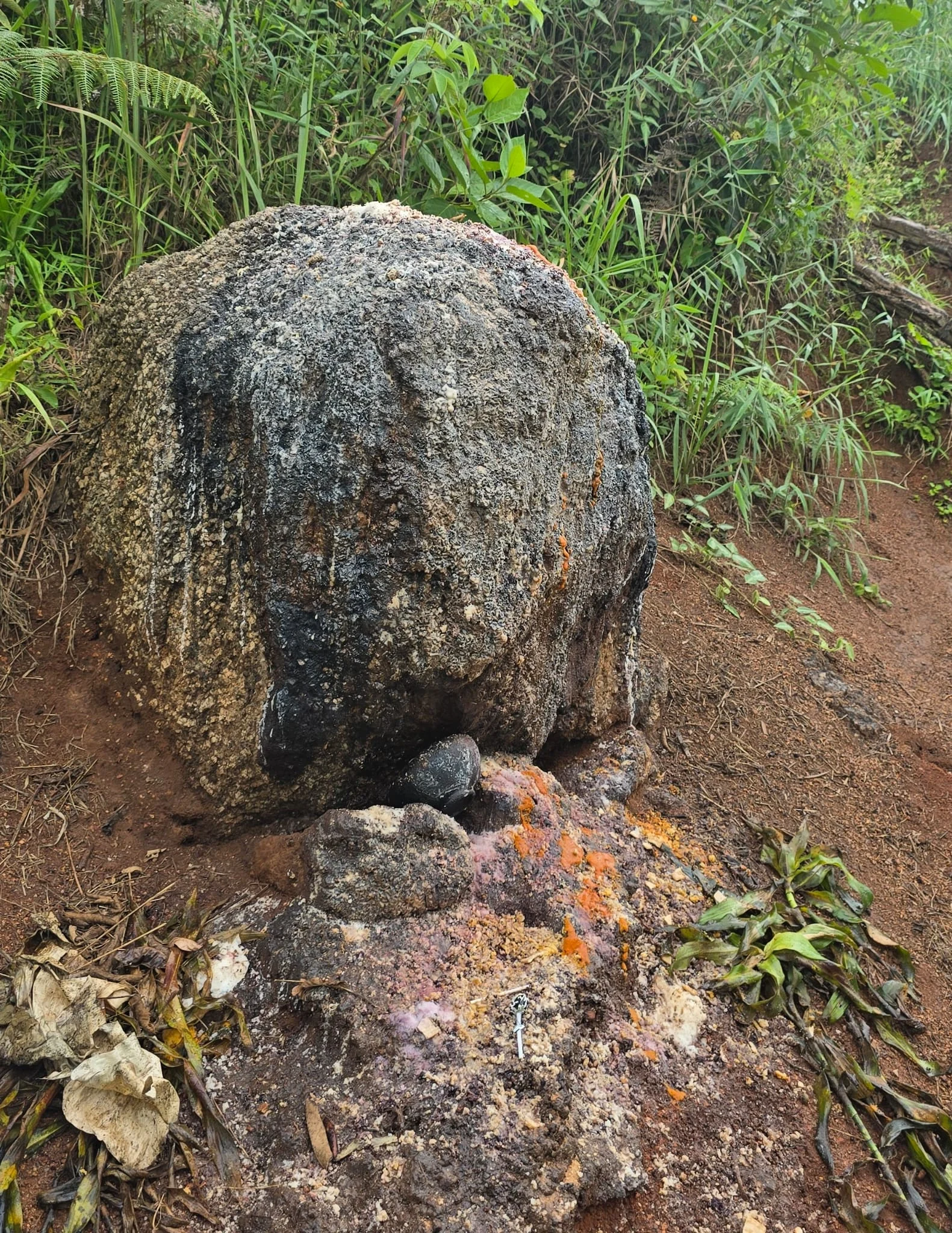
It refers to the offering made to deities during Bamiléké religious ceremonies. The act of making an offering is called ŋgwā' pↄↄ' (throwing the mushr...
Une poutre en bois sur laquelle sont gravées des informations, lesquelles renseignent généralement sur l’importance du lieu, les valeurs ainsi que la ...
It refers to the chiefdom, which is the most important place in the village. The chiefdom has a dual definition. Firstly, it refers to the territorial...
The peace tree is a shrub that can grow up to five meters high. In Bamiléké chiefdoms, it is one of the constituent plants of the bocage*, specific to...
A notable is a person occupying a high rank in a chiefdom (See No’h (nɔ̀’)). A notable acquires his title and rank either by succession or by recognit...
The grouping of people of a certain age category. The gaps between two age groups vary from chiefdom to chiefdom. The gap considered for a generation ...
Literally the man of the tarantula, he is a doctor and a diviner. He uses tarantulas or cowrie shells for divination. He also uses plants and sacred w...
The man of leaves or medicine is the community's chief doctor. He has a thorough knowledge of medicinal plants, but also of anatomy (Notue/Perrois 198...
This website uses strictly necessary cookies to function. We would also like to use functional and analytical cookies to improve your experience. You can choose to accept or decline.