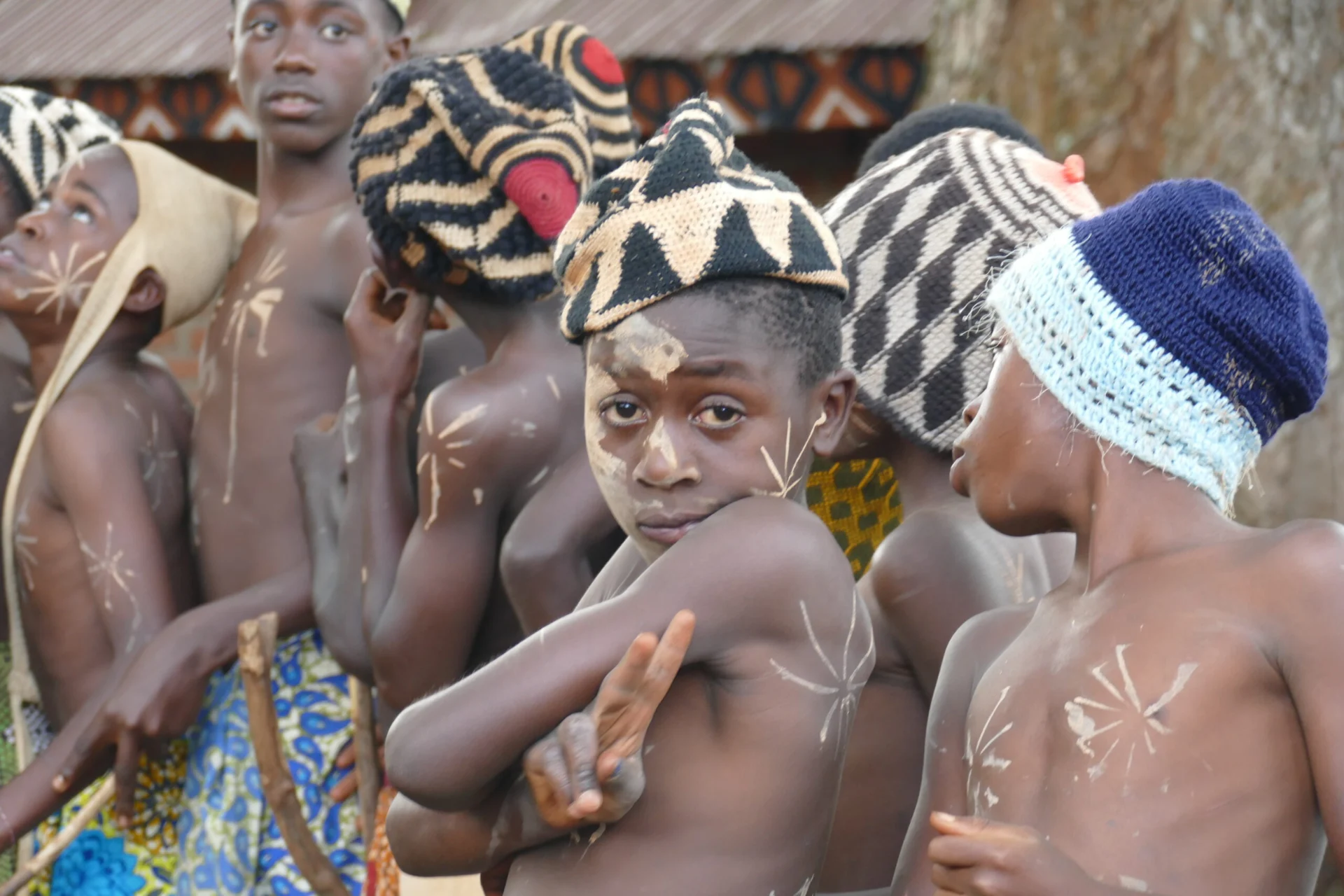
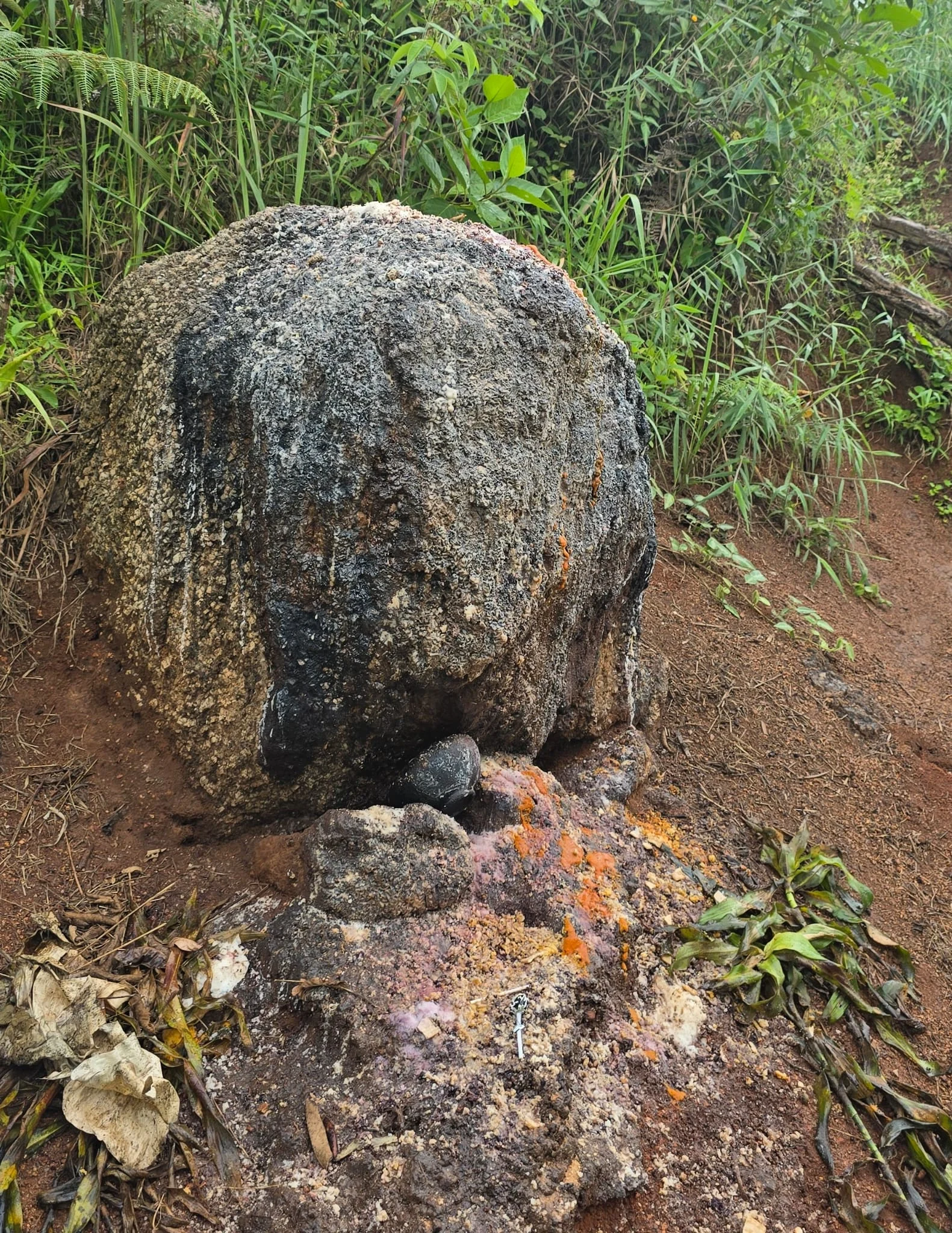
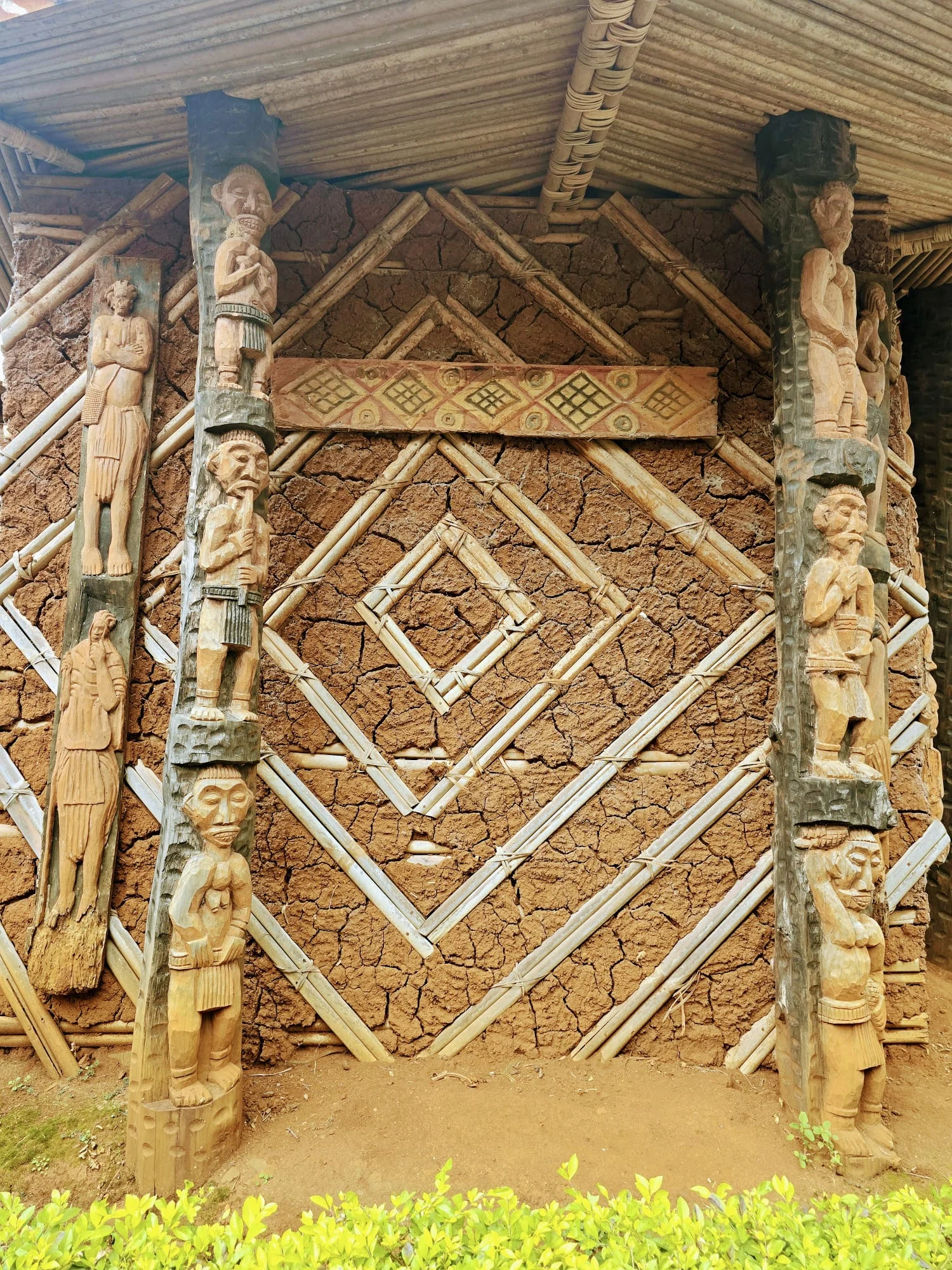
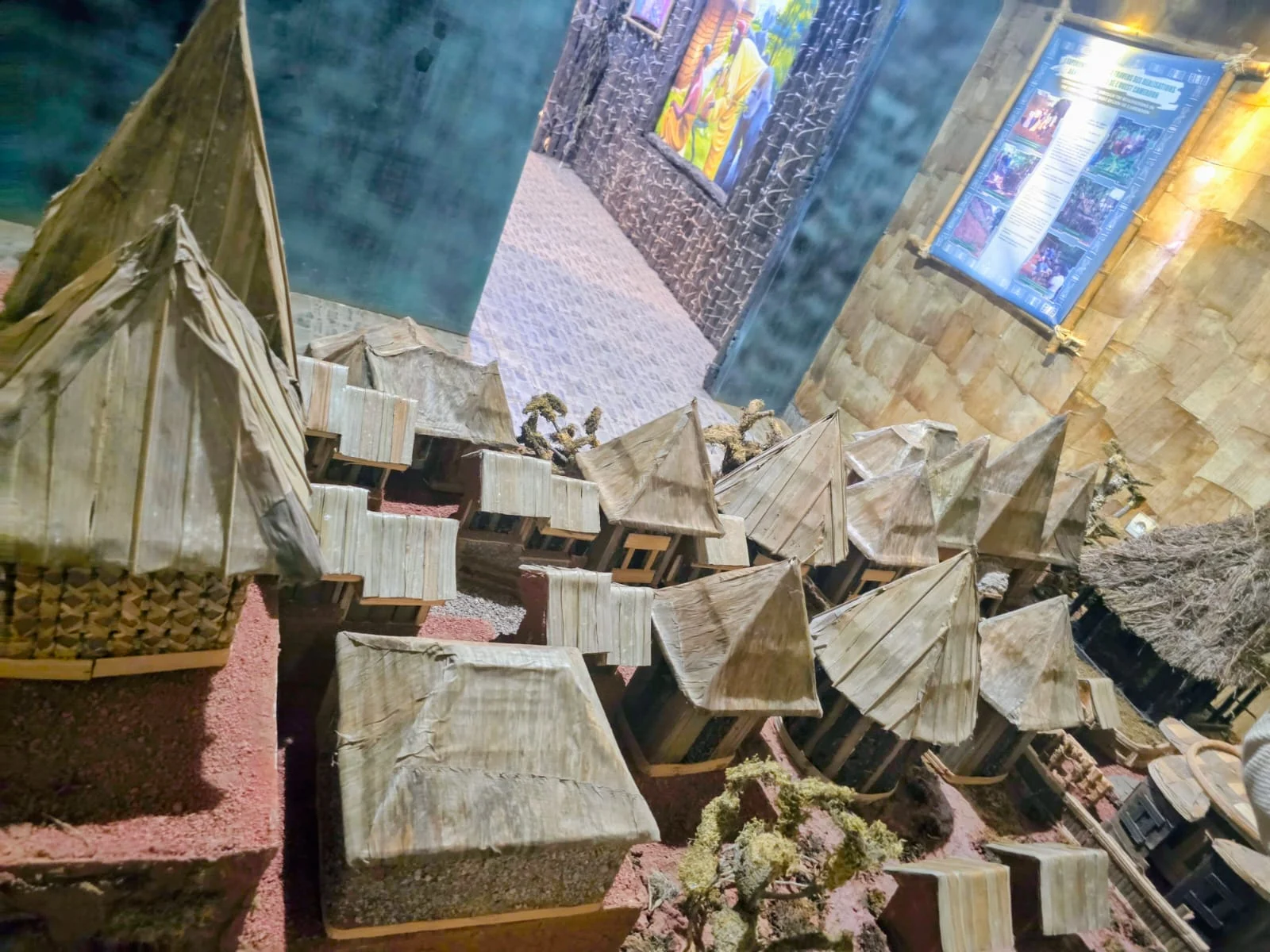
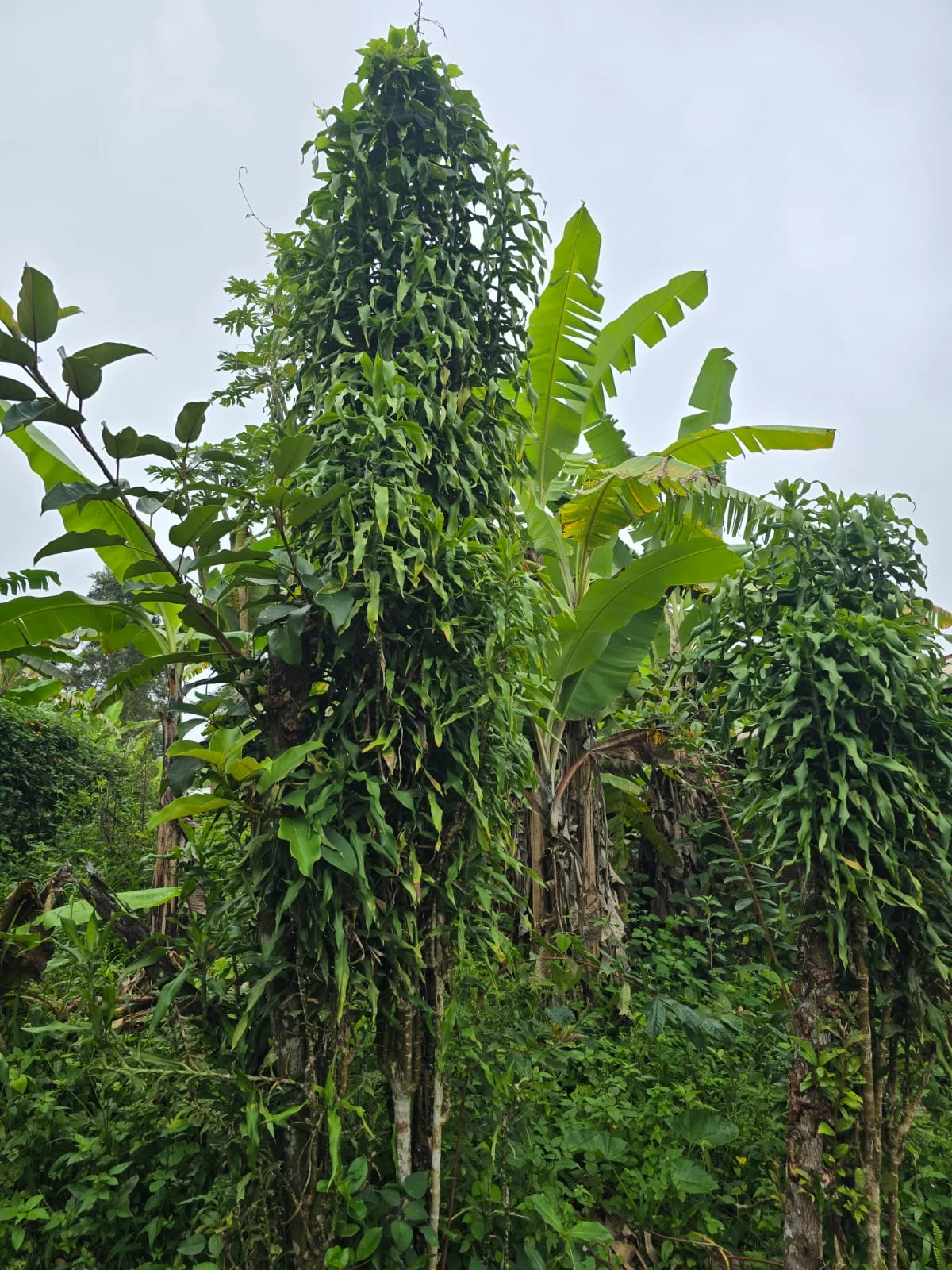
Une forêt ou un bois sacré que l’on trouve dans toutes les chefferies de l’Ouest-Cameroun et dans laquelle est préservée la biodiversité, elle aussi sacrée. Cet espace est défini par un certain nombre d’interdits qui facilitent sa protection et sa conservation. Ainsi, la chasse, la culture, et la coupe d’arbre y sont proscrites. Ces forêts et bois sacrés sont des lieux de culte plus ou moins importants selon leur densité et histoire. La forêt sacrée entoure le palais royal. C’est en son sein que se trouve le cimetière royal dit fem ou fam en Yémba, les maisons des crânes* des différents chefs, et les maisons dédiées aux réunions des sociétés secrètes* (Salpéteur 2010, 22). La forêt joue également un rôle essentiel dans l’initiation de tous les nouveaux chefs. C’est là que prend lieu leur stage initiatique de pré-intronisation d’une durée de neuf semaines appelé la’akam* (Saha 2008, 114–116). Ils y vivent reclus avec leurs femmes, leurs serviteurs, et leurs initiateurs. Ils y apprennent les méandres du pouvoir et l’histoire de la communauté, tout en se connectant aux ancêtres et à la nature.
On distingue entre une forêt et un bois sacré. La forêt occupe des étendues importantes tandis que le bois sacré est beaucoup moins dense. Les bois sacrés sont hiérarchisés selon qu’ils hébergent des divinités tutélaires d’une concession*, d’un quartier, d’un village, ou d’une sous-chefferie, ou encore d’une chefferie*. Leur importance est marquée par l’étendue du bois qui varie d’un seul arbre à un hameau. En tant que lieu sacré, ces bois reçoivent régulièrement des sacrifices et des offrandes provenant des populations qui leurs sont connectées. Ils se trouvent sous la prêtrise d’un Djwisī ou d’un Nkemsī.
A sacred forest or woodland found in all the chiefdoms of West Cameroon, in which biodiversity–also sacred–is preserved. Such spaces are defined by a number of prohibitions that facilitate protection and conservation. Hunting, cultivation, and cutting down trees are forbidden. These sacred forests and woods are places of worship of varying importance, depending on their density and history. A sacred forest surrounds the royal palace. It contains the royal cemetery known as fem or fam in Yémba, the houses of the skulls* of the various chiefs, and the houses dedicated to the meetings of secret societies (Salpéteur 2010, 22). The forest also plays an essential role in the initiation of all new chiefs, for it is here that their nine-week initiation course, known as la’akam, takes place (Saha 2008, 114–116), and where they live in seclusion with their wives, servants, and initiators. It is in the lefēm that those being initiated learn the intricacies of power and the history of the community, while connecting with ancestors and nature.
A distinction is made between a forest and a sacred grove. Forests occupy large tracts of land, while sacred groves are much less dense. Sacred groves are classified according to whether they house the tutelary deities of a concession, a district, a village, a sub-chieftaincy, or a chiefdom. Their importance is marked by the size of the wood, which may vary from a single tree to a hamlet. As sacred places, these woods regularly receive sacrifices and offerings from the populations connected to them, and fall under the priesthood of a Djwisī or a Nkemsī.

The word means hat. There are many different types, from royal headdresses to simple hats, Nkam (ŋkǎm)' hats and headdresses worn by the members of t...
It refers to the offering made to deities during Bamiléké religious ceremonies. The act of making an offering is called ŋgwā' pↄↄ' (throwing the mushr...
Une poutre en bois sur laquelle sont gravées des informations, lesquelles renseignent généralement sur l’importance du lieu, les valeurs ainsi que la ...
It refers to the chiefdom, which is the most important place in the village. The chiefdom has a dual definition. Firstly, it refers to the territorial...
The peace tree is a shrub that can grow up to five meters high. In Bamiléké chiefdoms, it is one of the constituent plants of the bocage*, specific to...
A notable is a person occupying a high rank in a chiefdom (See No’h (nɔ̀’)). A notable acquires his title and rank either by succession or by recognit...
The grouping of people of a certain age category. The gaps between two age groups vary from chiefdom to chiefdom. The gap considered for a generation ...
Literally the man of the tarantula, he is a doctor and a diviner. He uses tarantulas or cowrie shells for divination. He also uses plants and sacred w...
The man of leaves or medicine is the community's chief doctor. He has a thorough knowledge of medicinal plants, but also of anatomy (Notue/Perrois 198...
This website uses strictly necessary cookies to function. We would also like to use functional and analytical cookies to improve your experience. You can choose to accept or decline.