The supreme being of the Grassfields cosmogony. It lives in the afterlife and is master of the visible and invisible worlds.
The words Ndem (emptiness) and Sī (earth) refer, in the Bamiléké religion, to the supreme divine entity. (Fojionang, 2019) The word Ndem reveals the Bamiléké’s philosophical conception of the divine or, more broadly, of creation. The supreme being, defined as the original void, reminds us that it is from this void that life emerged. Furthermore, the supreme being is brought back to the earth (Sī). It is both the origin and the end of the world. This end is marked by death and burial. Emanating from the void, the Ndem, human beings return to their creator after death, becoming dust once again.
While the entity Ndem refers more specifically to the unique, omniscient God (Tsyapuɔ Ndém reads: God who surpasses all), its synonym Sī refers rather to its polytheistic diversity. Indeed, it refers simultaneously to the one God, divinities and spirits. Its relationship with the earth supports the perception of the earth as the domain of God and all that is divine. Thus, God does not reside in heaven, but beneath the earth. It is believed that there is a subterranean afterlife called Nzemsī* (under the earth), from which emerges all that is of the divine order or possesses divine characteristics, such as twins (Pō Sī*), their mother (Mέŋī Sī*) or diviners (Djwisī* and Nkemsī*).
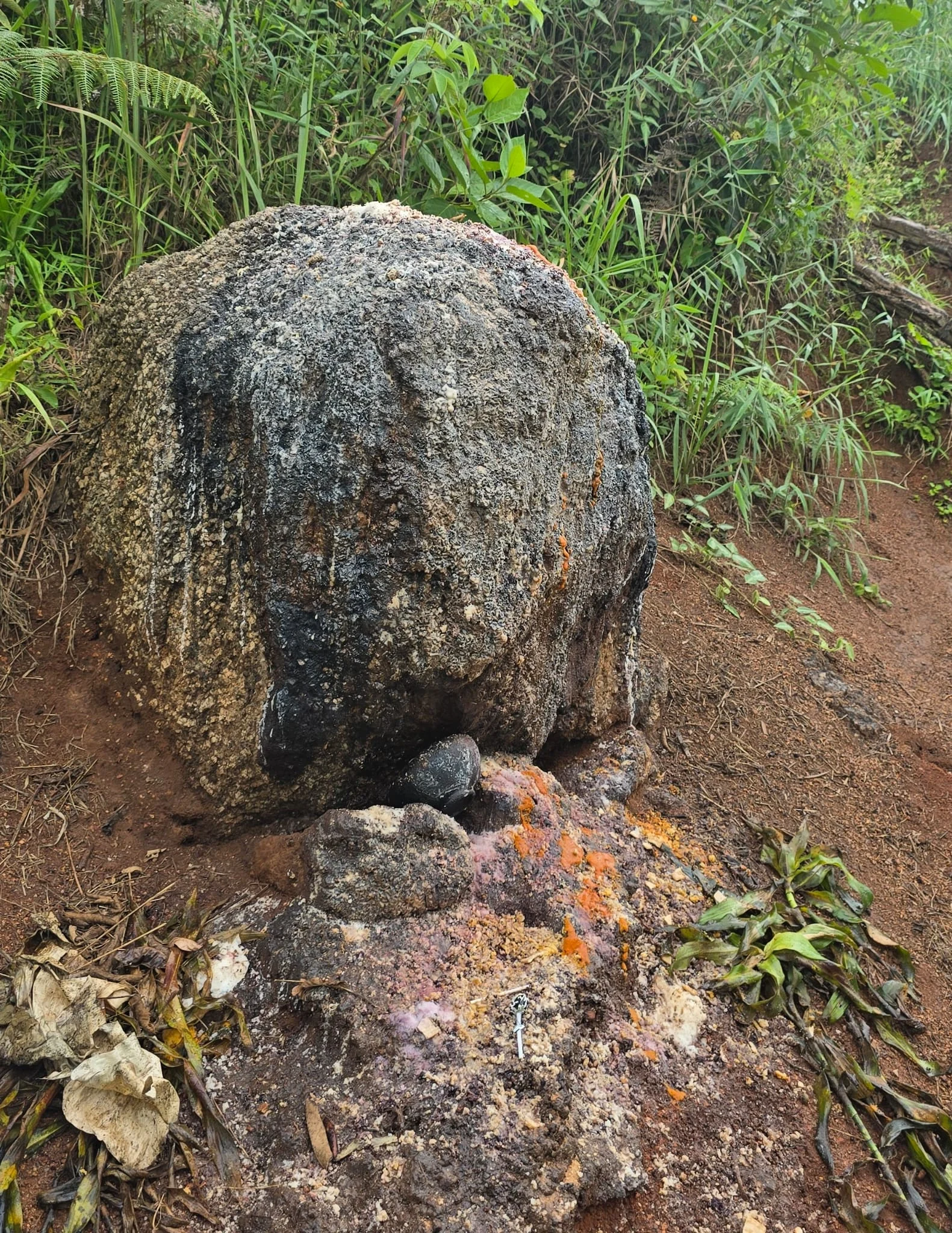
It is also home to spirits, beneficent deities and ancestors. As the home of the divine, the earth plays a key role in cosmogony. This is why it is regularly the subject of purification rites, which enable it to be freed from harmful spirits. There are guardians whose functions are to some extent dedicated to this task (the Mέŋī Sī* society, the Kuŋgaŋ society, Ŋgyā nzhɛ).
L’être suprême de la cosmogonie Grassfields. Il vit dans l’au-delà et est le maître des mondes visibles et invisibles.
Les mots Ndem (le vide) et Sī (la terre) renvoient, dans la religion bamiléké, à l’entité divine suprême. (Fojionang, 2019) Il est le créateur de toute chose. Le mot Ndem permet de percevoir la conception philosophique que les Bamiléké ont du divin ou, plus largement, de la création. L’être suprême, définit comme le vide originel, rappelle que c’est de ce vide qu’a émergé toute chose. Par ailleurs, l’être suprême est ramené à la terre (Sī). De fait, en tant qu’origine de toute chose, il en est aussi la fin. Cette fin est marquée par la mort et l’enterrement. Émanant du vide, le Ndem, l’humain retourne, après sa mort, vers son créateur en redevenant poussière.
Si l’entité Ndem désigne plus spécifiquement les qualificatifs de Dieu unique, créateur de toute chose et omniscient (Tsyapuɔ Ndém se lit: Dieu qui surpasse tout), son synonyme Sī renvoit plutôt à sa diversité polythéiste. En effet, il désigne en même temps le Dieu unique, les divinités et les esprits. Son rapport à la terre permet de soutenir la perception de celle-ci comme le domaine de résidence de Dieu et de tout ce qui est divin. Ainsi, Dieu ne réside pas au ciel, mais sous terre. On croit qu’il existe un au-delà souterrain appelé Nzemsī (sous la terre) et d’où émerge tout ce qui est de l’ordre du divin ou qui en possède des caractéristiques, tels que les jumeaux (Pō Sī), leur mère (Mέŋī Sī) ou encore les devins (Djwisī et Nkemsī). C’est aussi le lieu d’habitation des esprits, des divinités bienfaitrices et des ancêtres. En tant que lieu de résidence du divin, la terre tient une place capitale dans la cosmogonie. C’est la raison pour laquelle elle fait régulièrement l’objet de rites de purification, ceux-ci lui permettant d’être libérée des esprits néfastes. Il existe des corps de gardiens-nes dont les fonctions sont dédiées à cette tâche (la société des Mέŋī Sī*, la société Kuŋgaŋ, Ŋgyā nzhɛ).

The word means hat. There are many different types, from royal headdresses to simple hats, Nkam (ŋkǎm)' hats and headdresses worn by the members of t...
It refers to the offering made to deities during Bamiléké religious ceremonies. The act of making an offering is called ŋgwā' pↄↄ' (throwing the mushr...
Une poutre en bois sur laquelle sont gravées des informations, lesquelles renseignent généralement sur l’importance du lieu, les valeurs ainsi que la ...
It refers to the chiefdom, which is the most important place in the village. The chiefdom has a dual definition. Firstly, it refers to the territorial...
The peace tree is a shrub that can grow up to five meters high. In Bamiléké chiefdoms, it is one of the constituent plants of the bocage*, specific to...
A notable is a person occupying a high rank in a chiefdom (See No’h (nɔ̀’)). A notable acquires his title and rank either by succession or by recognit...
The grouping of people of a certain age category. The gaps between two age groups vary from chiefdom to chiefdom. The gap considered for a generation ...
Literally the man of the tarantula, he is a doctor and a diviner. He uses tarantulas or cowrie shells for divination. He also uses plants and sacred w...
The man of leaves or medicine is the community's chief doctor. He has a thorough knowledge of medicinal plants, but also of anatomy (Notue/Perrois 198...
This website uses strictly necessary cookies to function. We would also like to use functional and analytical cookies to improve your experience. You can choose to accept or decline.