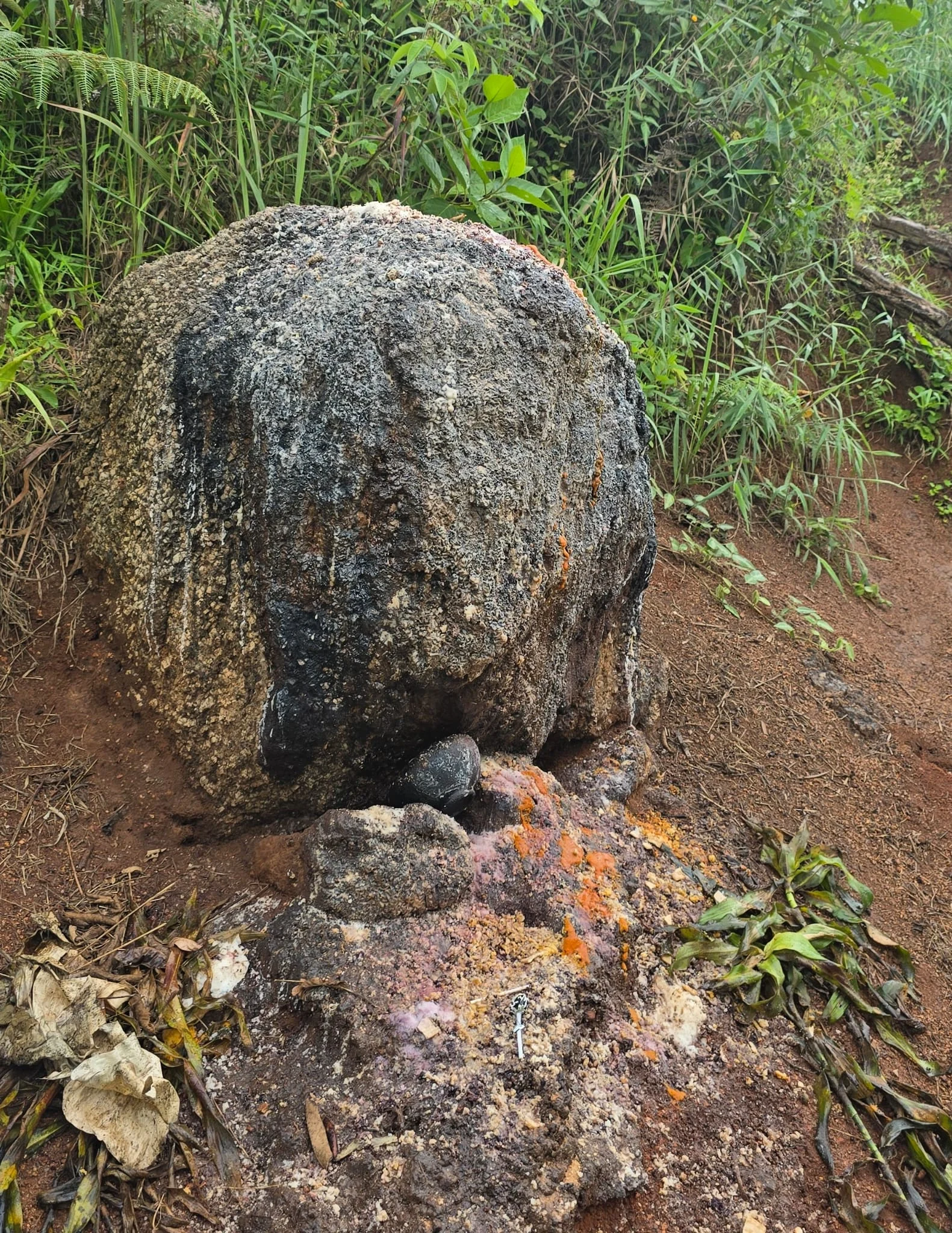
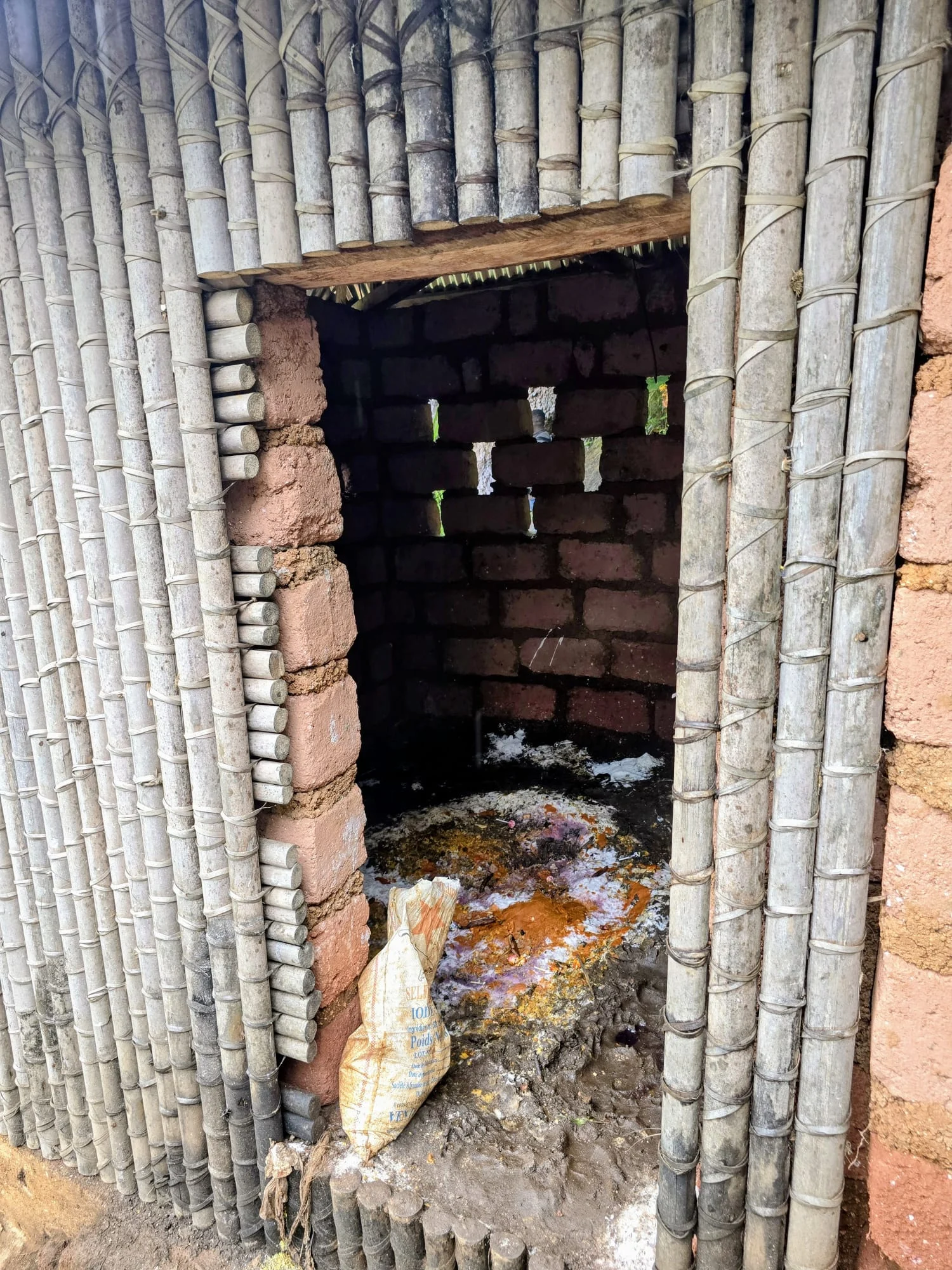
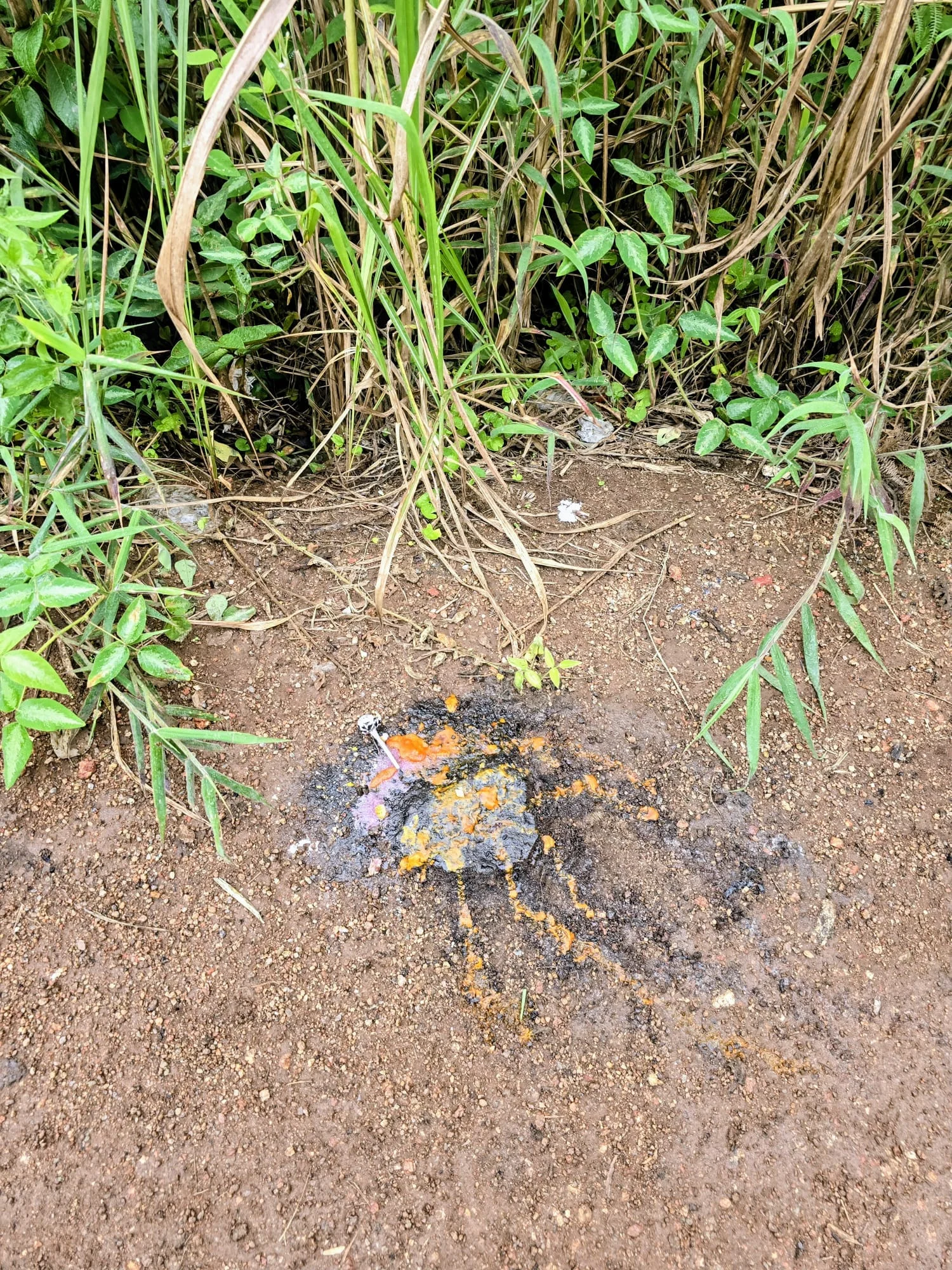
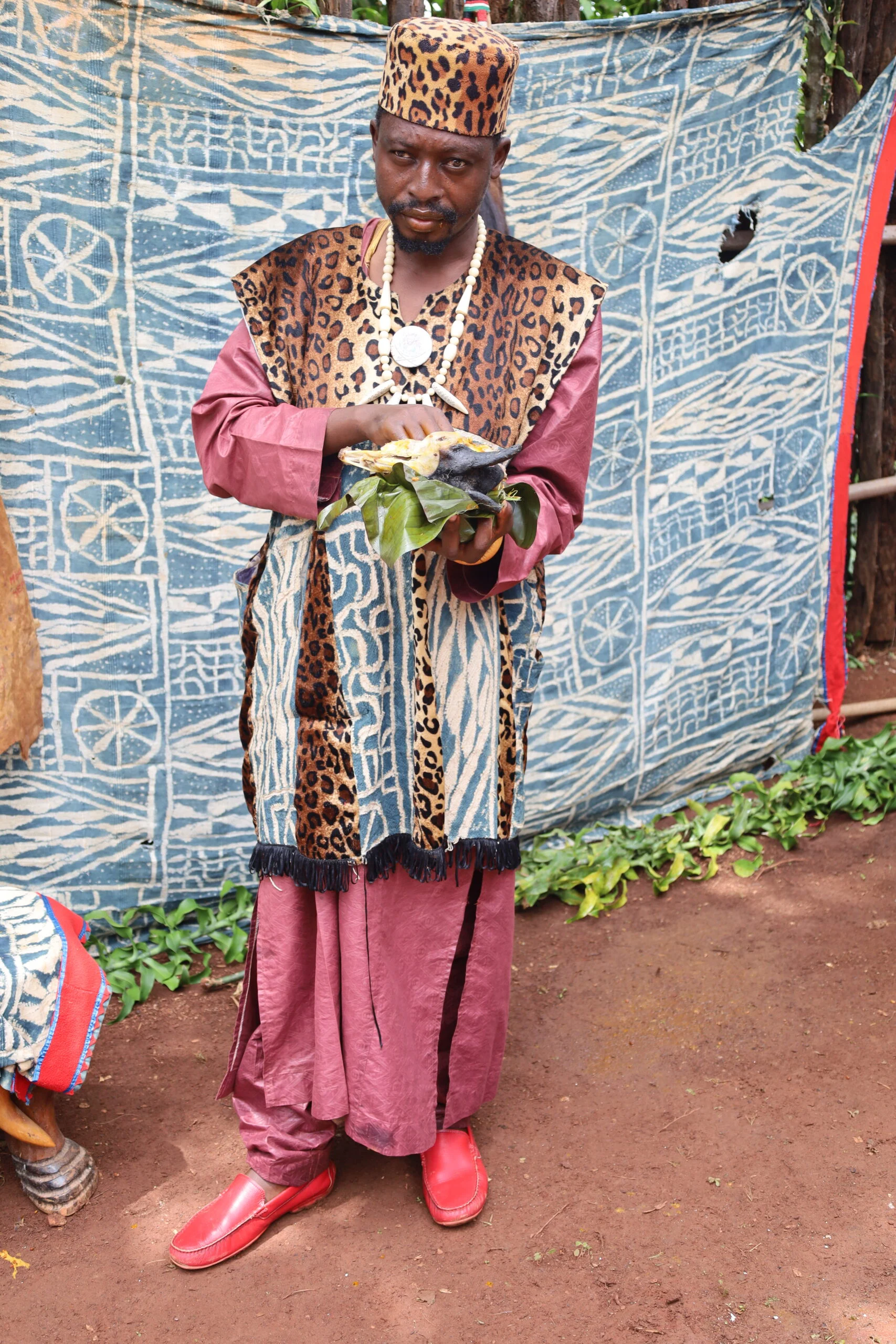
It refers to the offering made to deities during Bamiléké religious ceremonies. The act of making an offering is called ŋgwā’ pↄↄ’ (throwing the mushroom). The connection with the mushroom is a reminder that it was originally mushrooms that were offered as an oblations. (Manakeu 2024) Agricultural evolution and the diversification of foodstuffs gradually changed this offering, which nowadays consists of corn and pistachio powder, white raffia wine, salt and red oil. All these foods are often blended into a mixture and placed either in the sanctuary, at the entrance to the house dedicated to the divinity, or on the object of worship, which may be a statuette, megalith or skull. In addition to these standard foods, the offering can also be a kola nut, coins or part of the ceremonial meal.
Offerings play an important role in religious services. In some cases, the act of offering represents a purifying gesture. In such cases, the offering is considered to be food brought to the ancestors. It maintains the flame of remembrance that we bear to the family’s spirits. In return, these spirits watch over the family’s well-being and prosperity (Pradelle De Latour 1974, 134).
Il désigne l’offrande faite aux divinités lors des cérémonies religieuses bamiléké. L’action de faire une offrande est dite ŋgwā’ pↄↄ’ (jeter le champignon). Le rapport au champignon rappelle qu’à l’origine, ce sont les champignons qui étaient offerts comme offrande. (Manakeu 2024) L’évolution agricole et la diversification des aliments a progressivement fait varier cet offrande qui est, de nos jours, constituée de poudre de maïs et de pistache, de vin blanc de raphia, de sel et d’huile rouge. Tous ces aliments sont très souvent mélangés et déposés soit dans le sanctuaire, à l’entrée de la maison destinée à la divinité, soit sur le support de culte qui peut être une statuette, une mégalithe ou un crâne. En plus de ces aliments standards, l’offrande peut être aussi une noix de kola, des pièces de monnaie, une partie du repas de cérémonie.
Les offrandes jouent un rôle important dans l’office religieux. L’action d’offrir représente, dans certains cas, un geste purificateur. L’offrande est alors considérée comme la nourriture que l’on apporte aux ancêtres. Elle permet d’entretenir la flame mémorielle que l’on porte aux mânes de la famille. En retour, ces mânes veillent sur le bien-être et la prospérité de la famille. (Pradelle De Latour 1974, 134).

The word means hat. There are many different types, from royal headdresses to simple hats, Nkam (ŋkǎm)' hats and headdresses worn by the members of t...
Une poutre en bois sur laquelle sont gravées des informations, lesquelles renseignent généralement sur l’importance du lieu, les valeurs ainsi que la ...
It refers to the chiefdom, which is the most important place in the village. The chiefdom has a dual definition. Firstly, it refers to the territorial...
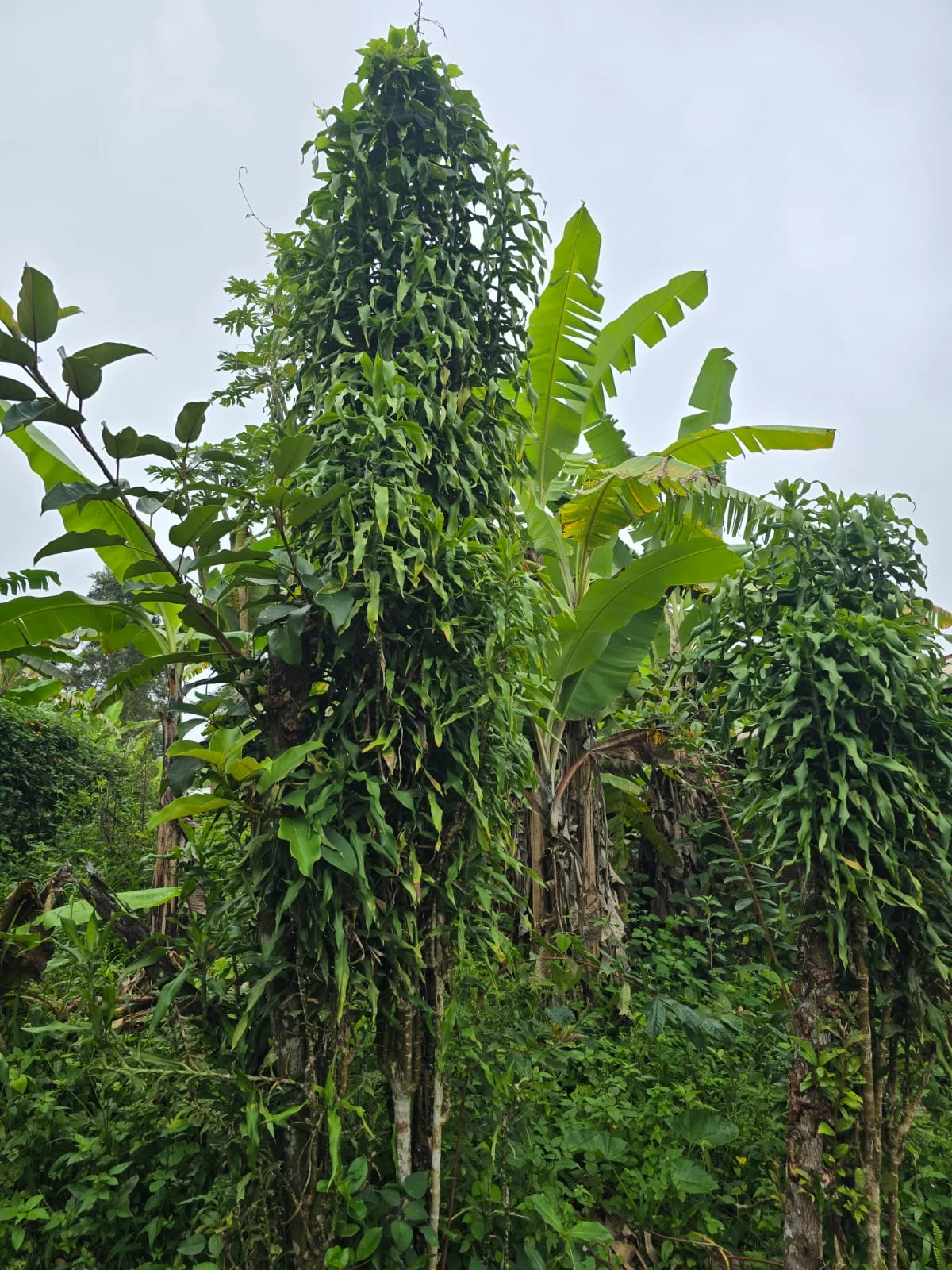
The peace tree is a shrub that can grow up to five meters high. In Bamiléké chiefdoms, it is one of the constituent plants of the bocage*, specific to...
A notable is a person occupying a high rank in a chiefdom (See No’h (nɔ̀’)). A notable acquires his title and rank either by succession or by recognit...
The grouping of people of a certain age category. The gaps between two age groups vary from chiefdom to chiefdom. The gap considered for a generation ...
Literally the man of the tarantula, he is a doctor and a diviner. He uses tarantulas or cowrie shells for divination. He also uses plants and sacred w...
The man of leaves or medicine is the community's chief doctor. He has a thorough knowledge of medicinal plants, but also of anatomy (Notue/Perrois 198...
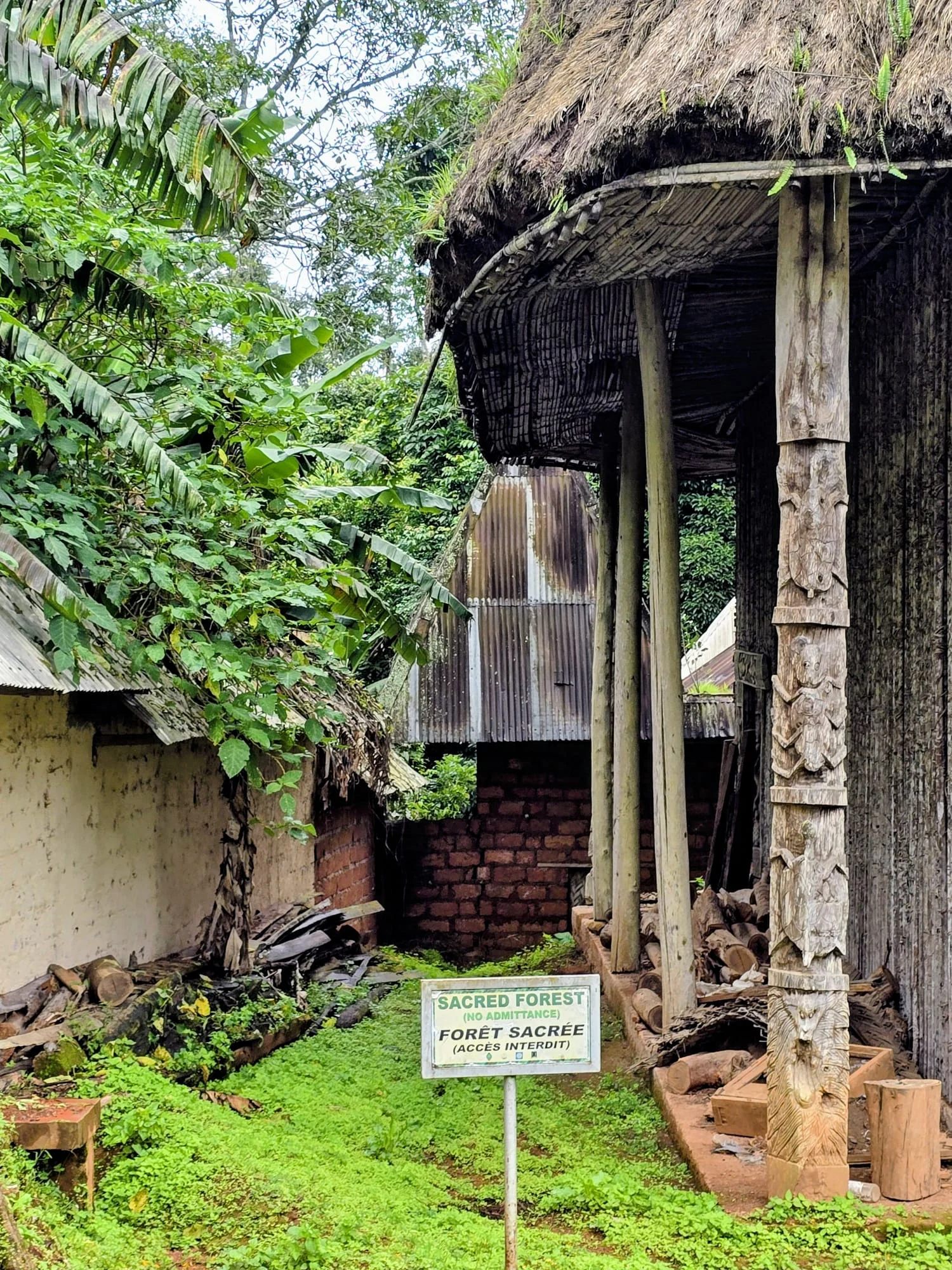
This sacred forest is located at the entrance or rear of the chiefdoms (see No’h (nɔ̀’)). It is a realm that represents the Grassfields in their origi...
This website uses strictly necessary cookies to function. We would also like to use functional and analytical cookies to improve your experience. You can choose to accept or decline.