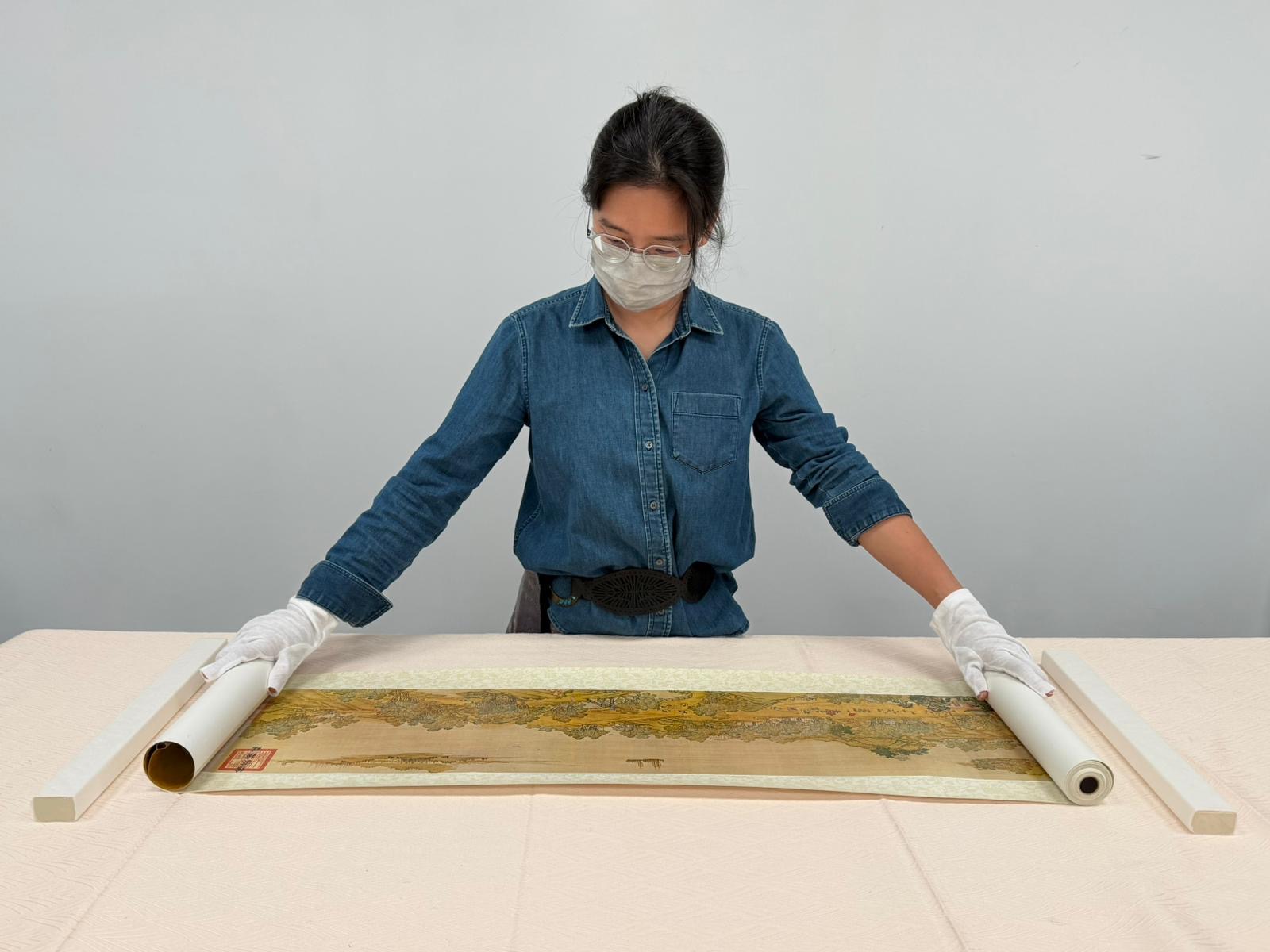
In the context of traditional Chinese culture, and in some other East and Southeast Asian cultures, the shǒu juàn/手卷 (handscroll) is one of the two major formats for painting or calligraphy. The shǒu juàn/手卷, literally meaning “hand-scroll”, is a long, narrow piece of paper or silk that rolls open from right to left horizontally. A handscroll usually measures up to several meters in length and around 25 cm to 40 cm in height.
Viewing in Motion:
This kind of scroll is intended to be read or viewed flat on a table. Due to its length, a handscroll is mostly viewed in sections, from right to left.
This means that the artwork—a painting or calligraphy—is usually not seen all at once. Rather, sections are viewed over time, intermittently interrupted by the scroll-handler’s closing and opening movements.
This means that viewers of a handscroll could see only one or several sections of the whole piece, without having an overall visual grasp of the complete handscroll.
The viewing experience of a handscroll, due to its innate physical characteristics, is often dynamic, with a hide-and-show effect that leaves a large space for manipulation controlled by the scroll-handler.
Another advantage of the handscroll’s horizontal structure, partial visibility, and temporal dimension, is that it allows for the depiction of a continuous narrative or journey, where the protagonist(s) can appear multiple times following the movement of viewing.
Standard Structure:
A handscroll usually has a backing of protective and decorative silk, the “wrapped-head/包首,” which usually bears a small title label (“inscribed-label/題簽”) on it.
At the beginning of the scroll is a wooden stave (“heavenly-pole/天杆”), which serves as a support. A silk cord (“ribbon/帶子”) and a fastener (別子) are attached to the stave and used to secure the rolled-up scroll. A “wooden roller/木杆” is attached at the very end, around which the scroll is rolled.
For traditional Chinese handscrolls, the scroll usually starts with a frontispiece (引首) at the beginning (right side), where the title of the artwork is given in large, spaced-out characters, often written by respected calligraphers. This section is known as the “heavenly-head/天頭.”
Following the frontispiece is usually the central artwork, the “painting-heart/畫心”.
After the “painting-heart”, there is often a section of colophon (“dragged-tail/拖尾”), and inscription or inscriptions that were added by the artist, the viewers, and the collectors over a long period of time.
In some handscrolls, additional vertical strips (“water-gap/隔水”) are added to separate different sections.
Most handscrolls contain only one painting, although several short paintings can also be mounted on the same scroll.
Social Dimension and its Connected Materiality
The act of viewing a handscroll in traditional Chinese culture is often a social activity, where a group of viewers gather in front of the scroll to look and comment as the scroll-handler moves from one section to another.
The surface of a handscroll can be modified in various ways by its own creator, its viewers, and collectors throughout the scroll’s lifetime in conspicuous manners, by adding stamps and inscriptions. These stamps and inscriptions can be added either directly to the main artwork’s surface (“painting-heart/畫心”), or to a separate section of paper or silk. For the latter, they usually appear in the “dragged-tail/拖尾” section, to the left of the main artwork and hence appear after viewing the main artwork. However, there are also cases in which additional stamps and inscriptions on a separate section are mounted before (or to the right of) the main artwork.
The inscriptions, added at collective viewing events or alone, contain a large range of content. They could comment on the history, content, quality, or authenticity of the artwork, they could be a reflections on art, life, and collecting, they could be documentation of the respective viewing event in history, or a specific interpersonal relationship evoked by this handscroll, etc.
Like the inscriptions, the stamps on a handscroll also materialize dynamic social interactions and historical traces on the surface of a handscroll. Stamps by the collector, first of all, state their proud ownership ostentatiously. Second, authentic stamps by famous collectors—such as Ming collector Xiang Yuanbian (项元汴),1525–1590—are given great significance as they reaffirm the value and authenticity of the given piece. Third, in certain cases, for example, an unconventional black (rather than red) stamp indicates that the owner was in a period of mourning.
A handscroll can be modified through remounting over the course of time. During the remounting process, sections can be added or removed. In certain cases, one handscroll can be split into two handscrolls and each of them takes on separately lives thereafter. The handscroll Dwelling in the Fuchun Mountains 富春山居圖 by the painter Huang Gongwang 黃公望 (1269-1354) is a famous example. Today, one section is housed in the National Palace Museum in Taipei, while the other is housed in the Zhejiang Provincial Museum in Hangzhou.
Conclusion
All in all, a handscroll (shǒu juàn/手卷) is an ever-evolving work of art whose material existence compresses both time and space in various ways. Its authorship and art historical value go beyond that of the main artwork in the scroll, as many other additions to the scroll—a piece of inscription, for example—continue to enrich and modify its original value and identity over time.


![Eighteenth-century watercolor drawing of a ceramics repairer in a Beijing street. Source: ‘Streets of Peking: [drawing]. Digitisation of RESERVE OE-55 (A)-4’, volume II © BnF Gallica.](https://glo-co.org/wp-content/uploads/2025/03/锔补_ju_bu.png)