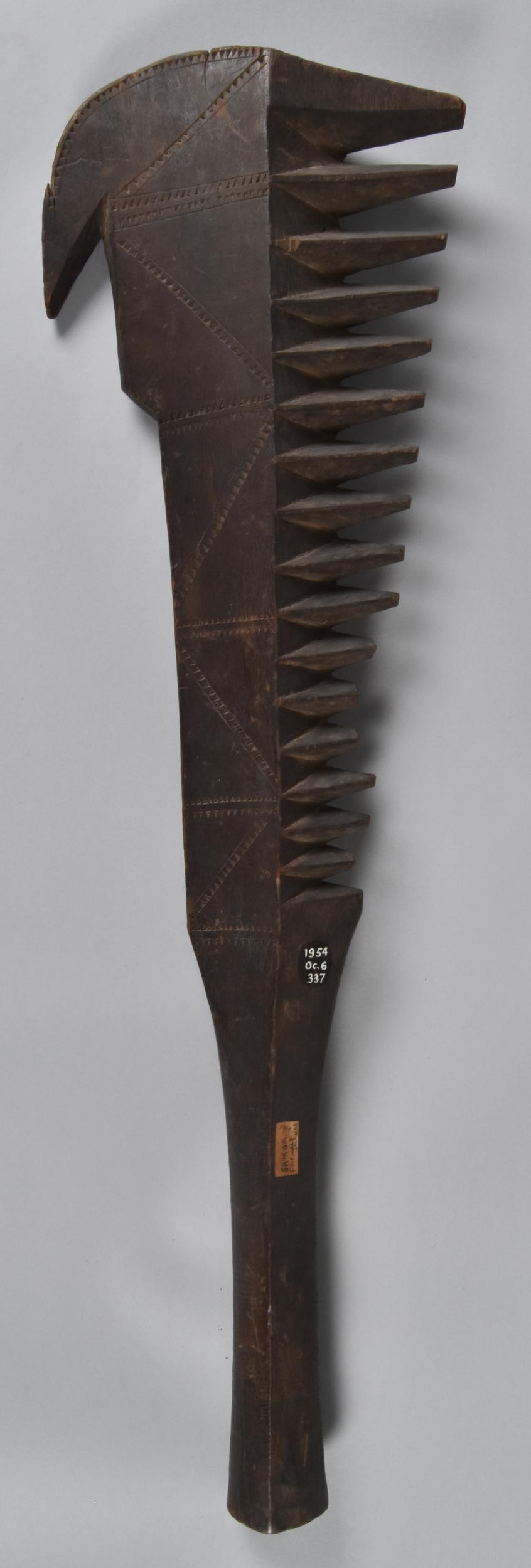
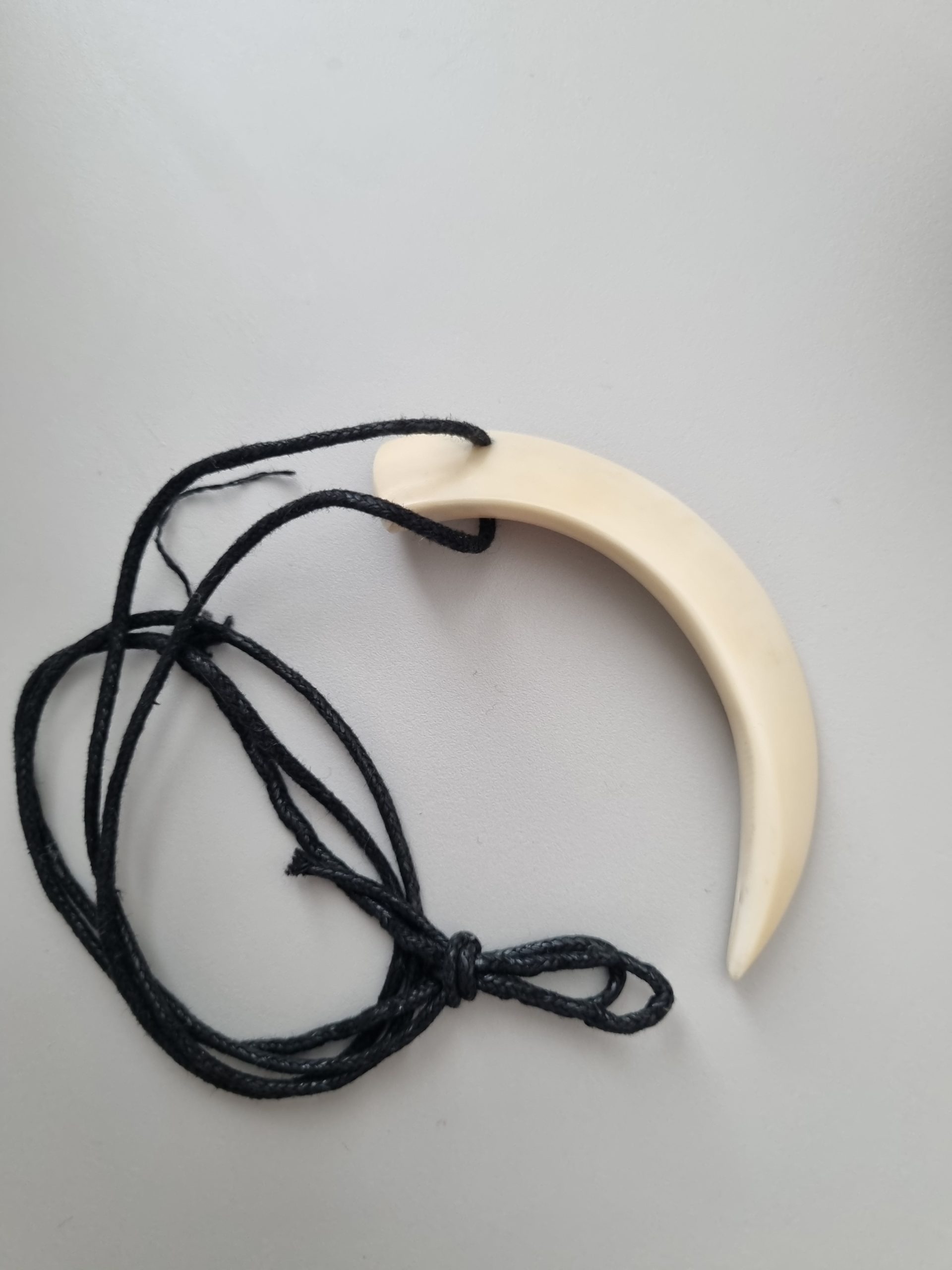
Parmi les nombreuses massues ou armes des îles Samoa, on compte un objet nommé le nifo’oti. Il était traditionnellement réalisé en bois de fer (très dense), le Casuarina equisetifolia, ou, plus tardivement, en acier, et avoisine les 70 centimètres.
Les spécialistes ont beaucoup discuté de la traduction de ce terme. Cet objet est défini comme « dent de la mort », plus étrangement, « talon ou pic ( ?) de la chèvre », ou « dent » (nifo’) qui « coupe » (oti). La dernière traduction semble la plus probable au vu de l’aspect de l’objet.
Cette massue était utilisée pour ses fonctions guerrières, notamment pour couper les têtes des prisonniers de guerre, ou pour des fonctions de chasse lors d’une période plus tardive, pour prélever la graisse des baleines. Techniquement parlant, cette arme se trouve entre une arme de frappe et de taille et d’estoc. A l’époque contemporaine, un objet similaire est utilisé dans le cadre de la danse nommée siva afi.
Among the many clubs and weapons of the Samoan Islands is an object called the nifo’oti. It was traditionally made of ironwood (very dense), Casuarina equisetifolia, or, later, steel, and measures around 70 centimetres.
Specialists have debated the translation of this term at length. This object is defined as ‘death tooth’, more strangely, ‘goat’s heel or spike (?)’, or “tooth” (nifo’) that ‘cuts’ (oti). The latter translation seems the most likely given the appearance of the object.
This club was used for warfare, particularly to cut off the heads of prisoners of war, or for hunting in later periods, to remove fat from whales. Technically speaking, this weapon is somewhere between a striking weapon and a cutting and thrusting weapon. In modern times, a similar object is used in a dance called siva afi.

Krämer, Augustin. (1903). Die Samoa-inseln. Entwarf einer monographie mit besonderer berücksichtigung Deutsch-Samoas. Stuttgart: E. Schweizerbart (E. Nägele).
Churchill, William. (1917). Club types of nuclear Polynesia (No. 255). Carnegie Institution of Washington.
Process of transferal of ancestral remains. This may occur for various reasons, for example when another family member passes away, and the family wis...
Made up of the words fale (house) and mata’aga (site to explore), falemata’aga is a Samoan term for museum, gallery, and other institutions for touris...
Kin. Family. This word is applied to the unit of extended family and within. In formal conversations, it can also be used to refer to your spouse.
As the lecturer and educator Dr. Niusila Faamanatu-Etetuati explains, “Land is fanua and is a very important measina* to Sāmoans, connecting them to t...
Fa’alelei comes from the words Fa’a (to make) and lelei (good). Fa’alelei can mean repairing a relationship or, in the museum context, an object. Fa’a...
Samoan customs and attitudes reveal devotion to tua’ā, with the deceased generally buried on family land and property. This allows the family to remai...
The ensemble of Samoan cultural treasures, art, codified movement, language, sounds, and customary practices—essentially all elements considered core ...
In Samoan culture, ancestral remains are sacred, and are kept and looked after by the families and descendants of the deceased. Attitudes toward thes...
This website uses strictly necessary cookies to function. We would also like to use functional and analytical cookies to improve your experience. You can choose to accept or decline.