Tila

Pronunciation: Ti-la
Language: Ewe

Description

Protective amulet common in Togo and other parts of West Africa in various forms. The term gris-gris is apparently more widespread for protective amulets from the region; however, my father, who is Ewe himself and grew up in Togo, refers uniquely to the Tila. The purpose of the object described in each case is similar, though the contents differ. These amulets feature in the widely practiced Voodoo religion, which is often intertwined with other belief systems. In Togo, as in many West African countries, the traditional natural religions, collectively referred to as Voodoo, are fused with Christian or Muslim religions; in the case of my family, with Catholicism. A Tila in the form of a leather bundle is typically given to children as a general protective amulet during events such as baptism, to shield them from harmful influences. They can be purchased in markets. However, where protection against a curse is sought—such as, for example, when someone has been cursed due to a conflict with another—a Tila must be specifically crafted for the targeted individual by a priest or shaman. In such cases, the shaman performs a ritual to identify the appropriate protective incantations. These are then written out, with each sentence on its own small piece of paper. The priest or shaman folds these pieces of paper into squares, blesses them, and thereby nullifies the curse. These are then placed inside a small leather bag, which is sewn shut and fitted with a leather cord, to be worn around the neck and tucked under the pillow during sleep. If the person wants to keep their protective measures hidden from the person who cursed them—that is, does not want to wear it openly—the pieces of paper are placed inside a larger piece of paper (roughly 1.5cm x 1.5cm) and wrapped up with adhesive tape to protect against moisture. Before wrapping, protective symbols are drawn on both sides of the paper. The person seeking protection is then to carries this bundle with them. The ritual process required to activate the amulet can last up to ten days, and involves drinks and chants.

Read more

Tila bezeichnet ein Schutzamulett, das in Togo und anderen Teilen Westafrikas in verschiedenen Formen verbreitet ist. Es ist eine Form eines Amuletts, auch bekannt als gris-gris, das ähnlich in islamischen westafrikanischen Traditionen verwendet wird. Der Zweck kann als ähnlich beschrieben werden, aber der Inhalt des Amuletts unterscheidet sich. Diese Amulette sind Teil der in der Region weit verbreiteten Voodoo-Religion, die oft mit anderen Glaubenssystemen verwoben ist. In Togo, wie in vielen westafrikanischen Ländern, sind die traditionellen Naturreligionen, die unter dem Begriff Voodoo zusammengefasst werden, mit christlichen oder muslimischen Religionen verschmolzen – im Fall der Familie der Verfasserin speziell mit dem katholischen Christentum. Ein Tila – in Form eines Lederbündels – wird in der Regel als allgemeines Schutzamulett an ein Kind verschenkt, oft bei Anlässen wie Taufen, und soll das Kind vor schädlichen Einflüssen schützen. Sie können aber auch auf Märkten gekauft werden. Zum Schutz vor einem Fluch – beispielsweise, wenn jemand aufgrund einer Auseinandersetzung mit einer anderen Person von dieser verflucht wurde – muss ein Tila speziell für die verfluchte Person von einem Priester oder Schamanen angefertigt werden. In solchen Fällen führt der Schamane ein Ritual durch, um die entsprechenden Schutzbeschwörungen zu ermitteln, die dann auf mehrere kleine Papierstücke geschrieben werden. Jeder Satz wird auf ein eigenes Stück Papier geschrieben. Der Priester oder Schamane faltet diese Zettel zu Quadraten, segnet sie und hebt damit den Fluch auf. Dieses Bündel wird in einen kleinen Lederbeutel gesteckt, der zugenäht und mit einer Lederschnur versehen wird. Damit kann der Betroffene ihn um den Hals tragen und es im Schlaf unter dem Kopfkissen verstauen. Wenn die Person ihre Schutzmaßnahmen vor demjenigen, der sie verflucht hat, verborgen halten möchte – also nicht offen um den Hals tragen will – werden die gefalteten Papierstücke in ein größeres Stück Papier (etwa 1,5 cm x 1,5 cm) gelegt und mit Klebeband umwickelt, um es vor Feuchtigkeit zu schützen. Vor dem Einwickeln werden auf beide Seiten des Papiers Schutzsymbole gezeichnet. Die schutzsuchende Person trägt dieses Bündel dann immer bei sich. Die Rituale zur Aktivierung des Schutzamuletts können bis zu 10 Tage dauern und sind mit Getränken und Gesängen verbunden.

Date of entry: June 18, 2025
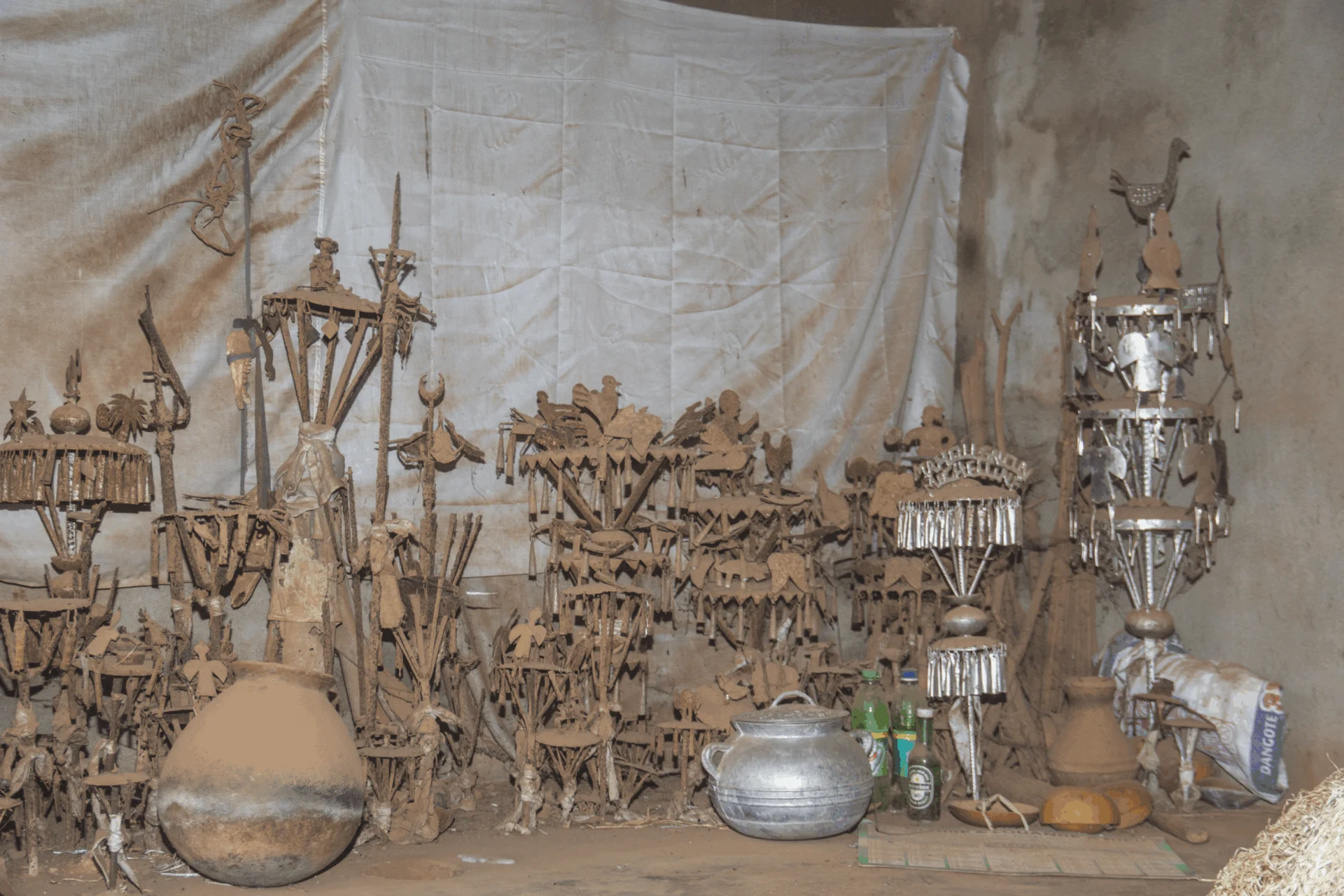
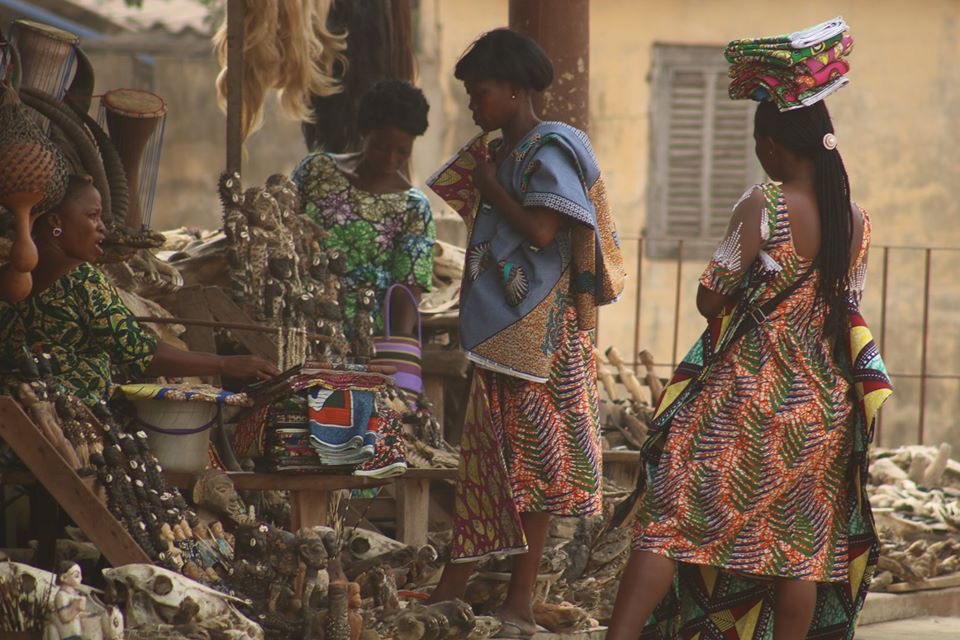
Fetish Market, Lomé, Togo. Lars Beineke, CC BY-SA 4.0, https://creativecommons.org/licenses/by-sa/4.0, via Wikimedia Commons
The name you would like to be credited with for your contribution.
The word you wish to contribute
Your email for contact and updates regarding your submission.
The language you are contributing the word in
Maximum file size: 3 MB
Maximum file size: 5 MB
By proceeding, I acknowledge and agree to GloCo's Legal notice and Terms of use
and the Guidelines for Contributors *

Related Words

IMG-20250912-WA0010
Géwél
Wolof

A person whose role is to be a historian, storyteller, poet and musician. They ensure the transmission of culture and oral history by preserving the m...

Asɛn
Asɛn
Fɔ̀ngbè

Originellement issu du Fɔ̀ngbè, le terme désigne un autel portatif fait de métal principalement, et réalisé pour commémorer un-e défunt-e qui, de son ...

tchambaga
Ewe
tcham-ba-ga

Bracelet whose name means “metal of the Tchamba,” the tchambaga symbolizes the iron shackles of enslaved people and is used to contact ancestors, as w...

Ataya
Ataaya
Wolof

Tea prepared on the ground in a teapot and served in cups. This way of making tea has its roots in the Arab world.

Ceebu jën
Ceebu jën
Wolof

Traditional Senegalese dish with fish, rice, and vegetables. In 2021, the dish was classed by UNESCO as an intangible cultural heritage.

Rouye
Ruy
Wolof

Porridge made with 'Sunguf' cereal flour, such as millet. The term Sunguf is also used to refer to any kind of flour.

IMG-20250827-WA0037
Bassari
Wolof

Animist people from the Kédougou region (South-East Senegal). Their religion is subject to stereotypes, as is the case for other religions, such as Vo...

Chéchia
Chéchia
Wolof

Square cap worn by men and women alike. This word, of North African origin, is rejected by certain Senegalese socio-cultural groups, who use Mbakhana*...

Tenguadé
Tenngaade
Wolof

Conical straw hat often used by Fulani people when accompanying their herds.

Mbakhana
Mbakhana
Wolof

Cap worn in most Muslim countries, including Senegal. Occasionally referred to by the pejorative term Chéchia*.

error: